
By Mathilde Girard and Frédéric Neyrat
The margins of cinema
Frédéric Neyrat: Let’s start here: What is film’s place, and more specifically your films, in the entertainment industry of a capitalist economy? In other words, who is the enemy these days?
Elisabeth Perceval: It’s funny because yesterday morning I was saying to Nicolas… Do you remember?
Nicolas Klotz: Yes, I was asking Elisabeth about our place in contemporary French cinema and she was saying that it was like an uncertain love… I found that very beautiful.
EP: Uncertainty is just that, a space of possibilities with impossibilities hiding like a fire under the ashes. The unforeseen is where something new emerges. I truly feel that our place is one of freedom called the margin. I mean to say, at once it’s a “secret garden” where we distance ourselves from agitation, and a “refugee camp” where we find ourselves turned away and expulsed in the face of the market’s domination… To work in the margin, without security, without comfort, plunging our private and professional lives into uncertainty, hazard, and risk; these are feelings very close to those of being in love. We have always worked from things we have picked up along the way; from encounters, friends, places, those who surround us, books. Little by little things are constructed through the use of things collected over the years. But our method provokes rejection and much mistrust of course. The industry needs to control, to plan, to search for security with “zero risk”- that makes me think that of the advert on Meetic’s website, “Love without risk, Meetic, Love assured at any cost” it’s kind of the same world, all that… It’s a process that works on duration; we are obviously far from these mathematic obsessions, from the established norms, and the film industry, like all markets, searches for minimum risk, to see the absence of risk, at least the financial backers are. We can see how the liberal world that keeps us all safe has today become a menace for not just feelings of love, but also for creativity. Love, like film, can’t exist in the absence of risk. It can’t avoid chance. Love, film- It’s life, it’s made up of encounters, it’s always chance. Film is an intellectual and loving adventure… We make films to try to reconstruct something from an age, something that is in progress. How do we do that? We don’t always know. For months it’s an underground, meticulous task that suddenly takes hold of what we do. When we start working on a film we know that we are in for three or four years of battle. You have to have them; I would say that film is made from endurance, and that film can’t exist without taking a stance and being true to your position in all senses of the word: with choices related to esthetics and politics for example, but also positions with actors, positions with crews, the camera positions etc… And as in life, taking a position in film isolates us; it casts us to the side, especially when these positions are ill-advised and often radical. Therefore I would say that our film’s place is found in certain isolation; film that is cast to the margin… but today those on the margin are not allowed to come together. We are alone, each to their corner. We handle it because of our anger- because there are feelings, poetry, friendship, love, and because they would like to convince us that all that no longer means anything. They would like to convince us that it no longer exists.
NK: With Low Life, what we were confronted with in terms of finance for example, and one could say that represents the film industry at this point, is Canal +; who quickly joined the film. The film industry opened the first door and gave us a chance to exist. Where we noted things was when the doors opened by La Question Humaine were closed: l’Avance sur Recettes and la Région Ile de France, which really isn’t the film industry, they are more like colleagues- filmmakers, producers… So, on that film, the difficulties were on this way…
FN: Any friends?
NK: In French film? … “Oh my friends, there are no friends!” Today there really is no longer true friendship between filmmakers in France, it’s a terrible defeat. That’s my feeling anyway. It’s a defeat that touches everyone from filmmakers to critics, and against which new filmmakers will have to fight in order to reach new cinematic horizons. I saw Garrel’s Les Ministères de l’art (1988) the other day. Eustache explains how Godard helped him film Le Père Noël a les yeux bleus and the bills he paid to finish the film. The film was a failure of Masculin Féminin. Garrel truly found himself halfway between the cinema of past and present; he’s a magnificent documentary filmmaker. In Les Ministères de l’art you can see the circular friendship between Garrel, Eustache, Akerman, Doillon, and Schroeter. You can see it in the shots, in the sound of their voices, their exchanges, and the difficulties they speak of. Getting these filmmakers together, you feel like Garrel invigorates himself and the others. It’s much colder with Jacquot and Techiné. With them it’s something completely different. There’s a minimum unity. You can feel the barrier between filmmakers who want in to the system and those who remain on the outside. In Elle a passé tant d’heures sous les sunlights, Garrel, who was asked how to film his son, questions Doillon about how he was able to film his daughter in La Femme qui pleure. Their dialogue is incredible. There are passwords between filmmakers, who are also sons and fathers, artisans, and there are strong solidarities. The “death of film” is also a death of friendship between filmmakers. I’m not at all nostalgic about that, I just have the feeling that there is an immense mess that I don’t know what to do with.
EP: Like all armies in times of peace, cinema is divided into clans, Godard said of the Cahiers period. I don’t know if it’s still true, this time of peace, because today we live in constant war. Economy, finance, it’s as deadly as a dirty war. Anyway, we will find that those comfortable with the system will be part of financial aid comities, panels of all sorts, and those selecting projects. They know well how to defend their territory, and have no scruples moving money away from films they consider bothersome, those films which don’t form part of their intimate clan. The frames of reference that our project’s sub-commissions send back to us show the great abyss that separates us from rich, modern, and consensual cinema. Those who call themselves the left have always been criticized by filmmakers who take the position… “You’re leftists”, It’s become the supreme insult, we’re struck by it in such an aggressive way that “leftist” ends up sounding like “terrorist”. Money has taken such a place, the financers, the chains, and exploiters mainly want “cultural” products that work, and because of that they need films that obey the established rules of business. What room is really left to really question esthetic, politics, art, or thought? Saying that, I can see a certain naivety in myself; people don’t care, market logic doesn’t care… It’s a numbers war, through which we have to obey the learned esthetic, the marketing; today there is an implicit rule of the rhythm of cultural objects, and more so in film, like there is a rule to the rhythm of transportation, food, sexual relationships, teachings… An ascent into frenzy, a demand for speed, as a manner of escaping anguish in the face of emptiness… The horror of dead times, the need for fast connections, it’s all an illusion, a lie, a collective anesthesia for our sensibilities. We aren’t the only ones who have to face this; we have to think about what conditions we can resist in order to give life to film without this label of conformity. The only way of continuing to make our films is to work outside the country, like immigrants, and fill this “Low Life” -like space. That’s what we try to do with our closest collaborators. We try to create a web of cooperation and exchange with philosopher friends, with writers… We try to develop ways of collaborating, not just with work, but also with contacts, relationships, exchanges, and this desire has become really productive. Production is life itself.
NK: Yes, how can we work together? That’s the essential question. Today, a lot of filmmakers have fallen into the logic of brands and icons. I don’t judge, I’m just commenting, it’s an objective statement. It’s the capitalist version of what happened with cinema in the USSR. To finance their films, a filmmaker must propose a representation of the world that capitalism wants- or could want– that’s representative. One must be a part of it, and believe it. Even one’s way of responding must participate in making capitalism sexier, younger, more modern, and more desirable. To transform Métropolis into an artsy trip. It’s a global mutation that obviously does not only concern cinema, and that proliferates the idea that we will emerge from history- and therefore the history of cinema as well. Continuing with Eustache, Jean-Pierre Léaud’s hooded coat in Le Père Noël a les yeux bleus was buried with Eustache after his suicide. The fall of the Berlin wall, the digital revolution… Eustache said that he couldn’t think of Marx on an empty stomach. It’s concrete, harsh. Cinema’s motor is history, not a collection of fetish images financed in order to make people believe that the world has become an artsy trip produced by contemporary capitalism. The money that finances this trip is made up of the trip itself and generates a multitude of connections, networks, and addictive phenomena. The problem is that desire, it’s violently pharmaceutical. A spectrum of hallucinogenic products has appeared that capitalism has circulated in order to praise its own glory and legitimize its methods of domination, its systems of policing, and its technological rituals. As an artist, how can you agree to participate in that? At the same time, how can you not agree to participate? The system’s network is so powerful that it has become practically impossible to escape it. To make a film it’s necessary to confront that with others, esthetically and politically. Out of exhaustion, a lot of filmmakers have given up on these questions- Europe will become a very cool trip where young sub-committee readers of ARTE France Cinéma receive iPads to read assembly line scripts. At the same time, young Greeks and Spaniards have taken to the streets in these last few days because they’re suffocating in this same ultra-rigid and predatory Europe where they feel there’s no future. It’s a Europe where they would defeat the mortal young to offer eternal youth to the rich.
EP: Readers of the sub-committees write in their notes at the beginning of scenes and dialogues in Low Life: “Young people don’t talk like that, they don’t think like that now…” The same thing happened with Paria, the same thing with the Africans in La Blessure, the same thing with the shots in La Question Humaine. What does that mean? It means that there exists a cinema of appearances, a cinema of reproduction that imitates and copies in a sad outside imitation cut from reality. Concerning words, what we hear is the psychology and its dramatic effects, a prefabricated and coarse representation of feelings. It’s a naturalism that doesn’t intend to be natural and is nothing more than a set of conventions, this mechanical reproduction stays on the surface. Since you have to identically reproduce what’s expected, of youth, of shots, of bums, of immigrants… it turns into a misery where conditioning substitutes experience. It’s vital to reject these lies. Going to the movies is an esthetic experience. It is to see and to feel things for the first time. It’s where it’s possible to see and to understand the whole of the world. We say that this naturalism, this famous nature, opposes realism. The real is never a given, real is realized. We have work a year, two years, with non-professional comedians, or with very young actors who will be in these films. We must start by talking about what we know, about what corresponds to us, about what is close to our own sensibilities and our own stories. To have the fundamental worry about relationships with what’s real. And cinema consists of a particular relationship with the real and the fictitious. Knowing, as Godard said that “Realism is never in any way exactly truth, and that of cinema is obligatorily retouched.”
NK: Let’s take an interesting word: fetish it’s the word that Whites have given to cult objects of primitive peoples that they found in the course of their colonial explorations. It also refers to someone who has, according to a superstitious person, a magical power and is admired without question. In psychoanalysis, a fetish is the lustful object of a fetishist. It’s the crossroads of an unbelievable power- colonization, superstition, domination, possession, and sexual perversion. Witchcraft. The power of bio-politics passes through this white, technological, and erotic magic that was extracted from archaic domineering relationships. It’s the will of pure power that takes possession of others. To survive as a filmmaker, to participate in the grand black capitalistic mass, authors- like all objects of the trip- must also circulate as fetishists do. They themselves become magic images, thanks to their own images. They enter into the economy of desire, married to the money that finances the colonial ambition of the trip. It’s necessary to see Antonioni’s Zabriskie Point again (1970). He saw this coming, a bit like Bresson with Le Diable probablement (1977). The white collared fascism, the police control, the youth, the consumption trip, the music of Pink Floyd. The trip is so powerful today that it makes your mind, your body, all borders explode. We must expand our world. It’s clear; the world as we know it today is too small, too dated, to handle this revolution. It’s a totally explosive situation that will last as long as seductive effects of the trip. Let it be us who expand the boarders and invent a new relationship with the community that invents new relationships with history, art, philosophy, friendship, love, politics… Let it be us who breaks the barricades behind these strengthened boarders and try to paralyze the privileged. That’s a civil war.
Mathilde Girard: Can one say that your place is that of a foreigner, or of an estrangement with French cinema?
NK: In this fast-paced world of change, I don’t have a clear idea of what French cinema really is. In relation to the history of French cinema, we are, like many French filmmakers, heirs of Vigo, Renoir, Bresson, Godard, Rouche, Eustache, Garrel… In relation to today, I don’t really know. In some senses, I could feel close to Desplechin and his romantic ambition. La Sentinelle for example, but that’s already long off. Dumont with Hadewijch. These are two filmmakers that really knew how to create independence in the heart of the French system. They are also two intense stories with their producers. I strongly vindicate the idea of belonging to French cinema without knowing what place we occupy in it. It’s not for us to say. Perhaps it’s a mutated place? In a certain way, it’s true that the financing of our films is a bit like Argentine, Portuguese, Catalan, or Thai cinema. Ten years ago, critics called these poor films- In relation to films called rich or in the middle. Even if these categories are a firm reality, I no longer have the desire to think of French cinema in that way. It’s too fossilized, too paralyzed, too dated, and too predictable. I try to think of it differently. Perhaps on the side of an International future and solidarity with other filmmakers and new generations, questions of aesthetics and politics will be consolidated. I try to think more in terms of fractures and the unexpected. Like everything that means something nowadays. A film might generate the unexpected. It might arrive at somewhere unknown, somewhere else. It might intrude. And it’s true that it’s become rather easy because there is so much money in French cinema that the system has become self-sufficient. There is no longer need for an outsider who is needed for the exportation of their products. In any case, no outsider needed for more than sales and territories. We made La Question humaine on our dime, on super 16mm film, with a budget 50% less than the base standard of a French film, and with French actors of many generations. Actors like Michael Lonsdale, Jean-Pierre Kalfon, Edith Scob, and Lou Castel, who form a part of cinematic history. Mathieu Amalric and Valérie Dréville who were in La Sentinelle. Nicolas Maury, Laetitia Spigarelli, and Delphine Chuillot, who are young passionate actors. The film worked well, and was sold in twenty-some countries. It worked so well that we had to pay for it.
EP: This story didn’t come from us, friends of ours told us, and they didn’t understand the enormous difficulties that we encountered in financing Low Life. Now that we are made to financially contribute something, I don’t know anything. La Question humaine was made on a very low budget and its there that we see that it’s possible to make ambitious films. There were issues raised about the subject, that’s something else, but to arrive at making a film like La Question humaine with 1.3M, it applies a certain theory of functionality to cinema, even while we know the exorbitant side of many films. Making ambitious films on a small budget is tempting to generate an alternative economy for film, and to show that it works; it creates tension on the system. We know this very well. On top of that, we intend to make films for the theatre. LQH sold 150,000 seats, the film found its audience, or at least it sold more seats than the average independent film. But there’s the danger! The audience shouldn’t have to spare themselves the trouble! Marguerite Duras said: “For professionals, the reproducers of cinema in opposition to the authors of cinema, we are wrongdoers who take ‘their’ money. And this margin of 10,000 spectators is something that the majority of quantitative filmmakers, against the currents and true to their films, will never have. This is why they detest us. In spite of their millions of tickets sold, they want to take our ten thousand spectators”. After the success of LQH, we could hope that the process of financing the next film would be a little simpler. And actually, we couldn’t avoid drowning in problems. Three years waiting, with meetings to explain ourselves, more waiting, then repeating our explanations. All this just to laboriously arrive at putting together two dimes, enough for a film budget from an emerging country but with all the costs associated with salaries, finding materials, decorations, transport, production fees of wealthy nations. The few doors that were opened were now violently shut in our faces. We said that we were stubborn, that surely it was a reproach… In any case, we had to think that way. Tenacity, as is said about love, it’s a tenacious adventure. Not giving up, knowing that carrying each film from its conception to its completion is a true challenge. A miracle. How long might we still have? As long as the wind of revolt blows…
FN: Because that will not have cost too much! As if the question wasn’t one of money needed for a film- that will always be too much in any case for the film- but financing that will be profitable for the industry itself… But let’s go back to this question of being foreign, or an outsider, on the fringe. In what sense is Low Life finally a film that allows for a fight against this self-sufficient relationship you were talking about, Nicolas?
NK: The word fight isn’t right. We can’t fight against that. How do you fight against a catastrophe hat has already happened? We have to organize ourselves well in our work in order to come back with new strength. I believe that it’s all good film’s own. That’s why the first films are often so innovative. They arrive without notice. What give cinema strength, its true strength, its singular intimacy and its collective power, is what decision makers what to exclude from cinema in order to keep it under control. It’s something invisible that is transmitted like a sound wave, totally outside of their will, and acts as a revealer to the community. Low Life is a film that is full of hope.
MG: Yes, and that makes me think that there is, in each of your films, the need to make a film a sort of asylum for rejected audiences. As if this marginalization that you are aware of, held accountable precisely the violence towards subjects which you form a part of. There is communication there between two communities, two scenes that capitalism opens in order to conjure that which we could unite under the headings of heterogeneous existences and cinema. It’s something like this, I think, that Deleuze understood when he talked about “Peuple que manqué”, and about how cinema is responsible for translating existence and giving it form.
EP: Of course, in relation to creators being cast out and excluded from their profession, what happens in front of our eyes every day brings us closer to others that are excluded, marginalized, disassociated… A lot of emigrants, Africans, Palestinians, Afghans, and Moroccans find themselves in situations, notably here in France, where they don’t feel close. We don’t have a want for opportunities to have these encounters, and that creates connections and friendships, which gives us a lot of confidence and hope. As we said, we find our subjects by an elective affinity, in life, in society, and but these encounters couldn’t become film if they did not correspond to personal feelings, experiences lived, or to anger.
NK: In Low Life, the Hussein character is a refugee who studies at the university, speaks French, is an intellectual, and not a manual laborer. He’s a young Afghan who, at a given moment, can be an illegal immigrant without necessarily being tied into a story of manual labor. This of course is very often the case. We wanted to expand, to open, not just place Hussain in a future of exploitation like the heroes of La Blessure who survived thanks to this type of under-the-table work… Hussein speaks to us from another aspect of globalization. It’s from a place of hope, where young people from different cultures are able to live in the same world and work together. He goes to the same parties and university as Carmen and her friends, but there’s something underneath in his head that keeps him in a state of exception in relation to others. His need for papers is why he publicly declares his desire to be a part of the community. But it’s also what suspends his rights to be human and forces him into a diabolic machine that ends up contaminating everyone he enters into relations with. To fall in love with Hussain is to enter in his fight against the machine, which generates fear, paranoia, exhaustion, and despair. The passion that Carmen shares with him quickly invades her with a paranoia that acts as a kind of destiny. It’s this intimacy of lovers itself that is under attack, and from there, the whole of the community. I like the expression of my friend Santiago Fillol a lot, which says that the French state slips on Carmen’s sheets. Something there plays with a curse. The state of exemption is a spell and that’s why it is so powerful. Other characters suffer these same effects, like young Hatian Julio who is arrested in the metro and sent to a hospital to have his bones checked. He becomes narcoleptic when the doctors tell him that his real age is not what is shown on his papers. This event makes him completely crazy. In taking possession of the body, medical-legal technologies prologues the administrative and judicial spell. The hypothesis of the film is fantastic in the two sense of the word: voodoo as a form of active resistance against a police state that we interpret as a state of the cursed. It’s about finding ways of conspiracy against the administrative curse: to throw spells at the police, and at the same time stave off theirs. Little by little we become part of a sort of civil war, a voodoo guerilla against the police. Low Life is a fantastic film.


The state of love and politics
FN: It becomes interesting then to understand what reads as capitalism, the State, and romantic relationships, as the three find each other at the end of the film. Love is a place of resistance, but it’s also a place where the State is introduced. Love becomes a largely biopolitical place, where powers collide. Do you envision love as playing a central place in politics nowadays? And if so, in what way?
EP: Yes, I think that the state of love should be saved. Love should be defended, because it’s threatened on all sides. Some aspects of love are put in danger because today we buy into a taking possession of the body, a singular appropriation where everything is meant to keep appearances. It’s a sort of capture, where our capacity to think, to feel, to see, are all affected and attacked. From the moment that the state slips on our sheets, it also slips on feelings that are destined to go wrong. Love has been beaten down; we must take a stand- not act as though feelings have always been there unaltered… The engagement of love is obligatorily a war against capitalism, because it is not capitalized. Love is irreducible to law. Theater, cinema, and literature are very often represented as asocial of love. “Lovers are not alone in the world”. The feeling of love is to be reinvented, within it of itself and within the reinvention of other things; Chance, the unknown, that’s where things went wrong. In the same manner, we enter resist the invader, we become combatant against love, when it is threatened by the fact that we deny its importance. Liberalism converges on the idea that love is a useless risk. Love gave birth to existence, like a collective zest that gives nearly the whole of the world its intensity and meaning. How can we not see a resonance between engagements in love and engagements in politics? For each, there is a conviction that can never be renounced. Secretly the momentum of love is an incessant call for a transformation of the world, a change to the report that made it. This pressing desire explicitly expresses the need of an upheaval, but one not under form, discourse, ideology, or political parties. Those who are twenty years old today, lovers of Low Life, who are engaged in life with all their desire, cannot say to themselves that everything has gone made, they can’t. They know that there is a curse and that it’s diabolic in a sense of the term. It’s probably the devil.
MG: Couldn’t we think that in this place where the community suffers, and where feelings of love are under attack, that cinema could be the space for inventing and reinventing what feelings can’t seem to produce for love and politics? What’s also interesting in the film is that you have worked with ambivalence. When you say Frédéric that love is a biopolitical place of excellence, that also supposes that the couple can be separated. There is something in the relationship between Carmen and Hussein that is forced into societal exclusion and wishes to find a rival. It could be that the lover’s community becomes totalitarian and only a woman can save her vain love by incarcerating a man. This is a very sensitive moment in the film. Hussein saves something of the community in leaving, because the condition of love is at the same time a place of resistance and something that can be turned into reclusion. To make love a political sentiment supposes that in love that which can turn against the community will not be saved.
EP: Carmen and Hussain don’t look to exclude themselves but look to find a space to protect themselves. It is society that hunts them, pursues them even into their bed… Falling in love with an illegal immigrant as Carmen does leads her into combat, and it’s the community that finds them entangled. The couple then becomes entangled in politics, because their friends will have to position themselves, to organize themselves. They must take courses and bring books to Hussain because he can no longer go to the university. But also they must make contacts to prepare for his escape to another town. Some will be left behind, or have to leave the apartment, the situation having become impossible. Outside, in a car, the police keep taps on the apartment, their presence ends up making them totally paranoid. Carmen finds herself confined to live a hidden life like those living in warring countries. As she discovers that her lover is faced with deportation, the couple has no other choice but to remain cloistered in their apartment. Carmen ends up no longer leaving the apartment at all, and without noticing it, a strange feeling of possession enters her. In order to protect their passion, Carmen will “kidnap” her lover, because society rejects their love. One night, the lovers go to block the entrance to their room with an armoire, out of fear that the police will enter. Hussain can no longer stand this enclosure. One afternoon he decides to go to the university, but Carmen opposes the idea and forbids him from leaving. She acts by instinct, like a chased animal hiding itself, to protect themselves against those who chase them. It’s an attempt to rediscover their violated intimacy. For them, possession is not a psychological feeling born from a strategy; it’s a physical feeling like the cold and the burning that consumes one entirely. It’s a shock for him as it is for her. Hussain understands that she remains hidden with him to keep watch over him. On one hand society forbade the presence of this adored and desired flesh, and on the other, Carmen cannot stand the idea that her lover be arrested and deported. It’s a nightmare, Hussain wants out of the relationship, they fight, and he searches for a way out: “Europe has a siege mentality, of cynics, mobilized against a menace, but which? It’s the thought of a world at its end, they don’t want to see it even as it is before our eyes, but the old world has already been erased”. I live hunted, but I can’t escape… I need to open myself, to hatch”… But not at the risk of losing their lives, says Carmen. Maybe, but this is not living, this is not a life, responds Hussain. This logic of “identity” that the law imposes on them goes as far as making criminal a romantic relationship. Carmen goes to the police station, summoned by an interrogator. Like a modern Antigone, she faces the police attacks and is condemned. She defends herself; we cannot ask a woman who loves a man to denounce him or to cast him to the street. She invokes the principle of civil disobedience: “I violate the law, but I violate it for something that is superior to law, and therefore I cannot be condemned.”… During this time Hussain runs away. He does not want his fight to affect Carmen. He left for love he will say. His action, obviously, is more complex. I think that he does not accept living locked up like a thief, and that this would be an enormous mistake for him. In taking the risks he took to leave Afghanistan, he must have other ambitions. Love came as a gift; the absurdity of a law transforms it into a nightmare. That is something that he can no longer accept.
NK: Carmen, like Camille who plays Carmen, is always on the fence between adolescence and womanhood. I wanted to film her mutation, to film her has a mutant. The scene where Hussain shaves her, the fact that an “illegal immigrant” shaves her…
EP: It’s a tradition… Future brides are shaved. It’s a ritual done between women. Hussain very naturally transgresses the tradition. His act expresses his desire to see the romantic relationship with Carmen last. In a way, he marries her.
NK: It’s also the place where the French enter this world! And that a young woman offers herself to the knife of a foreigner, that means something! For me this scene is connected to the administrative role of Julio. The bone test results accompany a copy of “République Française” that the Africans are burning in the courtyard of a squatter’s house. There are two very provocative images, two rituals that are also conjuring rituals. I wanted to film Carmen mutate before the eyes of Hussain and Charles. Her face is not the same as Hussain or Charles look at her.
EP: Charles is precisely not in the possession. He sees this miraculous state of love, loss, and abandon with all of the dangers that provoke these profound melancholy feelings. He will say to Carmen: “I would love to find you now that I’ve lost you…” He continues in his fight for love and keeps true to his engagement, the love for her, which is something heroic. Charles is part of a post Chernobyl generation, and now Fukushima. His perception of the world is not the result of a romantic or catastrophic confusion, but one of disastrous realities which he measures by irreversible damage. He feels that everything is going to hell, that humanity is dancing in an abyss and that it is possible that man at the bottom wants nothing but destruction. The risk of a major nuclear accident is a statistical certainty, and a satanic reality. It’s in perceiving the obscurity of present that one discerns the invisible light, and that one acquires the capacity to respond to the darkness of the moment. For Charles, that only think that is still possible to save is love itself. He is ready to give his life, because if not love would not be. His commitment is total, because the future will be love, or it won’t be at all…
NK: When you say that, the question of sacrifice comes to mind.
EP: It’s true; Charles asks himself if he shouldn’t sacrifice himself to save something else. But he will not do it; he refuses to bring death upon himself. He decides not to die, and it’s there that he sacrifices himself. The sacrifice is in the act of staying alive in a morbid world which refuses everything that ties us together. Where men have become vagabonds without a worthwhile country to return to. We have lost our country of birth. But Charles has the strong feeling that something is resisting, that the origins will always be there, and will resist. And it’s worth it to resist; painting, writing, dancing, making music…to rediscover what has been lost in art, I don’t believe in anything else, says Charles… A space where this loss can be remembered… Without life insurance, without retirement, without organized trips… He’s right, don’t you think? He no longer believes in his studies, society has disgusted him and he no longer wishes to participate in it. He has the impression of being betrayed.
MG: That also makes me think of something else that happens in the lovers bedroom, which is sleep’s return. In the same way that love is a community place, sleep is also a community space that weaves itself around Julio’s character…
EP: It’s a community space, and not only with mankind, but also with animals, trees, nature, rivers…
MG: There is also a form of resistance in this sleep. Between La Blessure and Low Live, we can see that the police create new weapons that penetrate the body’s interior, and sleep seems to be a way of escaping this surveillance, a way of reserving one’s presence, to hide from exploitation.
EP: Between the surveillance cameras, the radars, the police and all their arsenals of new technologies, man by instinct will always search for ways of escaping this predatory eye. In school they single out children that could have delinquent behavior- they install surveillance cameras on playgrounds, in hallways, in bathrooms- they catch people without tickets on the trains, they fire rubber bullets at peaceful protesters- the police controls man through their presence in the street and in the metro. Our towns are emptied of a part of their inhabitants- the poor are transported, evacuated to the suburbs- To one side the powerful, to the other the poor. The exploited and the exploiters, the controlled and the controllers, and as the other would say “The assholes of today are sincere and believe in Europe”… Our films carry traces of that brutality. In Low Life the police is in a state of veiled insomnia, in the air we breathe there is this toxic side of surveillance, that of a police society in fear. Deep down, our states no longer control this economic war. To ward off the inquisitors gaze, a “sleep mode” becomes a way of escaping it. The characters in Low Life look for refuge for the body, heart, and spirit: to forget a few moments of this joyless, old, used world until you get your fill as it moves through the skin of the sleeping, plunging into this sensitive world where all men dream in the same equality of sleep. The great sleep as big as the world itself, shared with those who sleep together… “No more pain, no more past, nothing more to distinguish me from other men, from plans, from animals, from flowers” days Hussain. Sleep is also a way of recuperating strength.
NK: Charlotte Beradt’s book Rêver sous le IIIème Reich, opens with a quote that I like a lot: „The only person in Germany that still has a private life is asleep”…
Presence of the fantastic
FN: How do these different questions which link surveillance and visibility to different aspects of our lives, how are they represented for you in the film? Could you tell us about the work you did with the images in this sense?
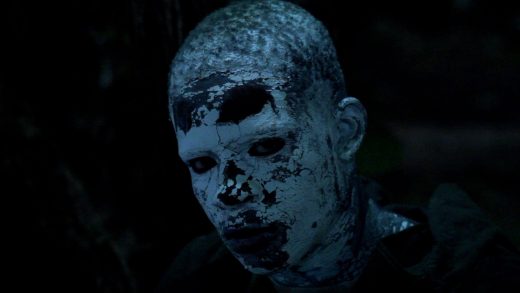
NK: When I shoot, I never think in terms of images. That doesn’t correspond to anything very concrete when working. An image is always linked to the way we talk about it, not how we construct it. At work, I talk about shots, about light, about camera position, about actors, about wardrobe, about real places… All the questions you ask, it takes a lot of time. While Elisabeth is writing, I’m kind of managing the next film, and that takes time. That too is concrete. Time it takes, the tools used to get into the writing. With Low Life, I had been really interested in everything that has to do with zombies and vampires, etc. Two years ago we made a film in Toulouse about these questions. We called that Low Life at first, then Zombies. The film lasted 1h20. It was laboratory work, a place of experimentation for the full length film to come. We only used fixed shots. A fantastic film that we filmed in 5 nights, at night, where we filmed zombies outside of their typical genre. They are telepathic zombies communicating by brain waves across town. They are immobile, suspended zombies. They recited texts from Ginsberg, Walser, Duras, Blanchot, Gabily, Lanzmann, Perceval… We filmed the circulation of these words through the town. We said to ourselves that these zombies were pre-revolutionary beings. They could grow almost anywhere in the world, like vegetables in frozen time- between rocks, the cracks, the show’s blinding lights, the performance’s ideology, velocity, and the business. In a certain way, they pre-shaped the young people in Low Life. Very often, when we talk about zombies, we confine them in to their genre. Romero, Carpenter, all that… Cannibalism, blood, American politics. We were more supported by cinema of the 30’s and 40’s. Movies by Tourneur, I Walked With a Zombie, Cat People, Leopard Man… or Victor Halperin’s White Zombie, Tod Browning’s Dracula. It’s about filming bodies, not monsters. That’s where we can consider the question of actors. Carmen, Hussain, and Charles. I realized, particularly when filming, that everything contains something fantastic, that everything radiates but that we can’t see it right away. Camille (Carmen) whose first time it was on film, gave this strange impression that she’s already appeared on screen, that she’s escaped from a silent film, from Murnau’s Sunrise, from Borzage’s films or from Tourneur’s Cat People. Even though she’s a young woman of 20 and absolutely from her own epoch- her way of speaking, her capacity to appear and disappear, to be at the same time mundane and a meteoric beauty- to be able to escape completely from psychology, naturalism, and formal poses. It’s in her. It’s her nature. Arash Naimain (Hussain) is at once completely present, a wall, solid, friendly, and opaque- we see him as worrisome. There is something vampire-like, something like Nosferatu. Carmen is drugged by his presence, like when women are in the presence of Dracula… Luc (Charles) appears in the film as an extremely brilliant beau, with this dry romanticism, a little cynical and desperate. Love’s warrior, as Elisabeth says. It may appear very feminine and provoke strange reactions of attraction from men imprisoned in their masculinity. It’s as much Eustachian as Bressionian. Luc is a wolf, sometimes even a werewolf.
F.N: Sleep, the state of being drugged, fantastical moments, are this a function of the police’s and politics’ inflexible will? Does the function of the fantastic, far from being a sort of narrative or cliché, have the effect of introducing an esthetic problem in the fight against police procedure?
NK: Absolutely. The first bio-politic films were Fritz Lang’s (German period) and Jacques Tourneur’s. Metropolis, M, Night of the Demon…It’s often even considered the beginning of film noir. Hitchcock’s The Wrong Man. That state of sleep, of being drugged, it’s also that of the spectator. We see that with Warhol’s work. As soon as a shot lasts longer than expected, something else happens, the gaze becomes more attentive and we begin to see things that trouble our understanding of the immediate reality. We ask ourselves if they are really there. We ask ourselves if we saw them or not. Did you see it? asks the female bus driver in Cat People. The relationship with what is out of the ordinary, with hearing things, transforms them. With Low Life, I wanted to accelerate this, to get away from duration’s hypnotic trick, to be more precise, and have that precision produce other disturbing effects. Well, there are still some rather long shots, but I was more interested in the relationship between shots rather than their length.
EP: We looked to produce disturbances, to try to break this damn spell. In the film, the fantastic is a way of conjuring destiny while avoiding tripping over the genre’s ‘stone‘. For example, the papers that the immigrants receive, their deportation notice, (Obligation to Leave French Territory) African’s call this document their “death notice”. We took this expression literally. These papers bring death. He who has them is in danger, and it’s the cops that control it, or the woman who slips it into her pocket. When the cop follows the young African, he throws it into the Saône to escape being caught. They both drown; the cop and the African become two victims of the curse of the damned papers. Animals also feel the maleficent presence and bark at he who carries it, they become cruel and bite. Luc, the actor that place Charles has something animal about him, in his body, in his movements, his gaze which plays with the fantastical. His presence gives Charles a feeling of a watchful animal, aware of the danger there, and keeping an eye on it. Charles is a kind of mutant, capable of passing through the ropes of the net, he makes himself invisible. Following the tracks of a fleeing Carmen, after the police department… It feels like we are a part of this nature, and we know that the ravages of this land uproot us all. In her sleep, the character dreams and speaks to us of a lost and forgotten world: in the forest there are berries in abundance, but no one can pick them… Before, we could not even see the world around us. It was like the sky, like air. As if someone gave it to us for always. As if it would last forever… Today children grow up in their houses. Without forests, without rivers… They can only see them in the distance, in their imagination. They are a different kind of child”. The young people in Low Life are born into catastrophe, and they will have to do something about it. Like the eye of a bison drawn on Julio’s bedroom wall, it watches the world and allows us to recover our sight and finally see the false promises that make us blind to the truth of what is happening.
NK: To expand on your question about directing, what I look to do is at heart to film what I see in the actors. How what they have inside of them works with the film. To keep up with that and with what Elisabeth wrote for them. It’s what is terribly fascinating and intimidating in Elizabeth’s writing. She has a way of constructing characters around the substance of their words and then how we find what they will say. As their words are often placed between address and confession, we must operate as in the theater. Not because she makes it theatrical, but to explore physicality, to experiment, to uncover false paths, the actor’s effects, psychology. We spent a lot of time with this, day and night, and we have a very close relationship. It’s what we saw in those moments, in these moments en life, that allow for connections with Elisabeth’s characters. It’s a strange, unforeseen alchemy that engages our feelings or ways of thinking, our solitude, and our fears together… Like a love affair across great distance.
EP: Thinking about the film, people talk to us a lot about “characters”. I have a duel feeling about that, at the same time the history of characters in cinema is true and false. It can be said that what unwraps actors, their presence, it’s something of a documentary, and that fiction goes word for word. The documentary side of presence is mixed together with fiction, and fiction has no other interest than being made valid by documentaries. Cinema is a peculiar relationship between reality and fiction. Once you’ve say that, everything is left to be done. In Low Life, apart from George and Miguel whom I knew and who are both musicians in real life, while writing, I don’t imagine any one person in particular with a precise look for such or such character. I am on the side of the inwardness of a character; their dreams, their desires, their anger, their fears, their worries, their obsessions… And while it’s what he does, he’s a student, unemployed, he works, and does he do anything? I say to myself, in this situation, what would he do? How would I want do see it. How would I like cinema to portray these young people. The characters are a kind of spokes person, for encounters that I’ve had, for my children, their friends. The writing is a result of all that, of observation, of the attention that we pay to the world around us. I imagined the characters of Low Life sometimes as survivors, as capitalist castaways, capable of reinventing everything; feelings, gestures, dreams, words to say. They are vagabonds in search of their native land.
During casting, I found myself in the presence of someone who was exactly the character I wrote, which was obviously something very perturbing and completely magic. In this case we both realized it, there was no doubt, and we met each other under strange circumstances. That’s what happened with Momo in Paria, to the point where the actor was asked if I had done research on his life. With Luc-Charles, the imaginary totally connected to reality. During the months of preparation, I could no longer distinguish Luc from Charles, It was a very intense and euphoric experience for Luc and I. We started shooting, and again the imaginary was there. It wasn’t just the character, Luc and Charles remained intimately tied.
Movement and the ellipse
MG: Upon seeing the film, I was marked by the feeling of closeness between bodies and desire. We are dealing with a presence that clearly belongs to tragedy, and we also clearly feel this movement, the displacements, a possibility left in the emergence of the event. In this way, I thought of Zombies, of Poptones, of films that accompanied your work on Low Life, and I remembered that these films were essentially filmed with fixed shots, while Low Life is filmed with movement and traveling. As if this maturity of body, time, and word was necessary to begin the process, to transport it.
EP: The movement, yes, to escape control of the curse, of being watched, to find impulse. Moving as to not be found, like in the past with the network of resistance movements. From the writing, I saw the characters in movement, movement of thought, of feelings, of body, all of which was intimately tied. At the beginning of the film, groups are moving, they converge on a squatter house; gather together, they are opposed together by the police force. But also they move in order to find their lover, friends, or rival… They move about, they walk, because there is no longer a fixed point of reference to fight in the name of. It’s a way of being neither in submission, nor in conflict but the live on a sort of moving tangent. The travelling companion, we find ourselves in the company of characters in action, in their interior movements, in their thoughts. They open the way for us, and we allow for other paths to be discovered. In movement there is also a feeling of worry, of development in the face of their future which holds them back. In La Blessure, the direction was constructed from fixed shots, a box that welcomes those who no longer know where to go. The exile who no longer has a place to rest, to dress his wounds, also a way of being solitary with their time, a place to wait…
NK: I would also say that I really love characters that I want to survive, that I want to follow day and night like someone in love! It’s also the first time that we filmed digitally. The direction is always a bet, a way of thinking about color and the way in which shots will relate to each other. Every film that we do is constructed from a bet on writing and direction. Paria for example is a fixed film, with a fixed camera, either moving or stationary; we filmed it without standing up. With La Blessure, we used fixed shots, with people who enter, stay, and exit the frame. La Question Humaine was constructed with direct and reverse shots. Low Life was done with movement and ellipses.
EP: And ellipses are just what escapes our gaze.
NK: You have to live with them to understand and follow their movements, if you are not with them, you hide from the movement.
EP: We cut a lot of scenes from the film that were already filmed. I believe that it’s the first time that happened to us. Fragments of the story came from filming itself. To keep them we would have had to have entered into logic that was too predictable. The story would have then taken control, it would have been more important than the feelings expressed. That’s it, a well-crafted story, it’s a way of controlling the characters, of making them puppets; we were no longer on life’s side, on feeling or reality’s side, and we were entering into trickery. The ellipse allowed for a larger field, which created acceleration in the story and a general movement in the film. To cut things is a way of leaving the audience with greater freedom, to leave the field free to their imagination. I believe that there were three films with this scenario, and also where I gave the most of myself. The characters are the age of my children and their friends, I know them from the inside out, I follow their lives, their injuries, their conquests, and their lost hopes. I’ve seen how the world has become gloomy over the last twenty years, but also how youth finds the capacity to respond to the darkness of the moment. The world has changed with great speed, and the young have taken to living with this velocity. We shouldn’t impede the fluidity of their movement, but neither should we feel their immobility when thought races, when they question one another, when that produces other movements, and when the community sees the hope that another world is possible.
Trembling youth
FN: On the voyage from Zombies to Low Life, there is a setting in motion, that’s to say something for a film that speaks of resurrection, of a love that is born in defiance of all that could impede it. And I would like to come back to the question of living, to the relationship between living and youth. We talked today a lot about youth as a revolutionary presence, in Greece, in England recently, and in France as well at the heart of the movement surrounding retirement, the youth have become very active and menacing against the actions of the authorities. I would like to ask you about this question of youth.
NK: There is an idea at the heart of the film that is that youth is not something new, but something very old. That’s why it has so much strength. Youth grows up without stopping at the ruins of the youth that came before them. There is an ancient force in youth’s present that can only strike fear in authorities. Be it from the state or from the family. I believe that the burning heart of the movie is to capture that on film. Maybe our three previous films allowed us this time to film our own ruins, the ruins of all the beliefs of our generation, and understand those of cinema… and the strength of those that will survive them. I believe in some way that youth remains the reason that cinema is, and that everything that makes cinema work does so in capturing youth; A young person who isn’t defeated because she will always have history’s power.
EP: The question is also one of capitalism, a promise that has turned to disaster. It is society that continually speaks to us about profits, of consumption, and which abandons youth. It is an all-powerful system that would like to make youth an obedient mass, to exploit them till death from all sides. Twenty-five of every one hundred young people are unemployed; we also see that rich countries are no better off than poor ones. In this paralysis, in this stagnancy, the youth reject it; they tremble with a glowing instinct for life… I don’t want to say any more, I try to show it, to make some of this trembling felt. And to promise to say something else, in making their words understood in a different way… The first cries of warning, we heard them in the streets of Tunisia, while our foreign affairs minister proposed sending the dictator the French police’s know-how to help in killing the delinquent groups. Then in Egypt, in Afghanistan, in Syria, in Libya… Now in Spain and Greece… It’s about breaking the spell of order, of this appalled impotence. And for them there will be no spokes person, no profit, no political parties, just the need to find the necessary agreement that will welcome in and bear the event. Making a film is like daring to take part in the event, to take part with the fable means of cinema.
NK: The French Revolution for example was composed of very young people. That’s what we want to work on in our next film… a sleepless youth. That makes me think again of a quote from Garrel in La Frontière de l’aube, “We are people who sleep, not people who make history”.
EP: And I would respond: We are people who dream. Meaning: We must be leaders and take our dreams for reality.
LUMIÈRE April 2011
Translated from French by Eric Allen Spring
 BLACKOUT ((LITERATUR, ÄSTHETIK & FILM))
Hinterlasse einen Kommentar