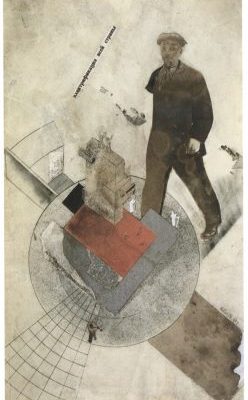
In Alexandra Kollontai’s own words, she lived many lives.1 Her life, brimming with events, relationships and disillusionment, is fascinating in itself. Reading Kollontai means tracing the life of a revolutionary through the numerous books, pamphlets, articles, speeches and actions that she took part in organising. We may differ with Kollontai on many of her choices, yet it is critical to contemplate the difficulties one always faces in being part of a movement with the passionate goal of forming a better world. Kollontai lived many lives surrounded by many loves, the greatest one perhaps being the 1917 October Revolution, which…

Tag: Friedrich Engels
Michael Löwy | Incandescent Flame: Surrealism as a Romantic Revolutionary Movement
What is romanticism? Often it is reduced to a nineteenth century literary school, or to a traditionalist reaction against the French Revolution—two propositions found in countless works by eminent specialists in literary history and the history of political thought. This is too simple a formulation. Rather, Romanticism is a form of sensibility nourishing all fields of culture, a worldview which extends from the second half of the eighteenth century to today, a comet whose flaming “core” is revolt directed against modern industrial civilization, in the name of some of the social and cultural values of the past. Nostalgic for…
Keston Sutherland | The poetics of ‘Capital’
A year before the first English edition of Capital was published under his supervision in 1886, Engels issued a brief polemic against the pretensions of anyone reckless enough to think that this great work could be translated into English by a mere amateur man of letters. The target of the polemic is Henry Mayers Hyndman, identified in the essay by his pseudonym John Broadhouse. After reading the French translation of Capital in 1880, Hyndman had published in 1881 a short book, England for All, two chapters of which were so thoroughly plagiarized from Marx’s work that they in effect…
Carla Lonzi | Let’s Spit on Hegel
The feminine problem is the relationship of any woman – deprived as she is of power, of history, of culture, of a role of her own – to any man: his power, his history, his culture, his absolute role. This problem calls into question the whole of man’s work and thought; man who has had no awareness of woman as a human being on the same level as himself. In the eighteenth century we demanded equality, and Olympe de Gouges went to the scaffold for her Declaration of the Rights of Women. The demand for equality of women with…