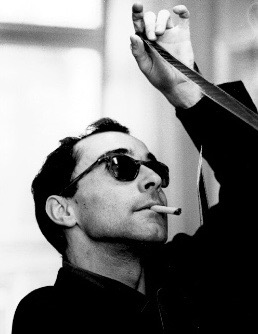
Few have noted that Chantal Akerman’s last film No Home Movie and her death in 2015 represented, more than any other work of art or event, the receding of a certain form of cinema and a certain way of thinking about film. While this formal and conceptual approach known as modern cinema has not yet come to an end, its adventurers have become rare; Chantal Akerman was the most singular of them all. For Akerman, ‘modern’ was probably not a rallying cry, but simply a word with ambiguous implications, such as when she used it in the first screenplay of Jeanne Dielman, 23,…
Category: Philosophy & Politics
Georges Didi-Huberman | In the Troubled Air…
Curated by French thinker Georges Didi-Huberman, the exhibition “In the troubled air…” sets forth a political anthropology of emotion in a poetic tone, sketching channels of respiration and resistance to confront the persuasive culture of capitalism which has filtered into everything. The title, taken from Federico García Lorca’s Romancero gitano (Gypsy Ballads), invokes emotion that flows beyond and is not constricted to one sole subject, where the Lorcian idea of “duende” (a state of heightened emotion or expression) comes into play. Where emotion is understood here as a movement transmitted to collectiveness via a unique body, one that is predisposed to develop into a…
reading list [6/2025]
Leslie Kaplan | Miss Nobody Knows Chantal Akerman | Eine Familie in Brüssel Jean Daive | Antonio Gramsci Jean Daive | Le Nœud EDITION RETOUCHES / ÄNDERUNGSSCHREIBEREI N°1 & N°2 Georg Wiesing-Brandes | Walter Benjamin. Das Pariser Adressbuch Lectura Dantis. Zeitgenössische Dichtung im Dialog mit Dante Alighieris “Commedia” Stéphane Bouquet | Tout se tient Stéphane Mandelbaum | Katalog. Museum für Moderne Kunst Annie Bourneuf | Im Rücken des Engels der Geschichte Eleanor Careless | Incarceration in the Poetry of Anna Mendelssohn
Peter Bouscheljong | parteinahme [ein fragment]
[…] der zustrom unterschiedlicher empfindungen durch das fliessen der worte (über und durch die haut) und die zersplitterungen eines wesens auf ein blatt papier zu übertragen. also verweigert sich die poesie einer repräsentativen logik oder einem solchen verstehen, lässt alle versuche einer klassifizierung in sich zusammenfallen. und man weiss, dass der negationismus zwei ressourcen hat, von denen eine darin besteht, nicht zu sehen, was in der tat nicht mehr sichtbar ist, während die andere darin besteht, den kontext der ereignisse biz zu dem punkt zu entfalten, an dem die besonderheit des verschwindens verschwunden ist.
Karoline Feyertag | The Art of Vision and the Ethics of the Gaze. On the Debate on Georges Didi-Huberman’s Book ”Images in Spite of All”
For Didi-Huberman the only thing to be gained from the Medusa myth is that it reveals Perseus’ victorious cunning—he having succeeded with the help of Medusa’s reflection in his shield in decapitating the monster. To survive and to bear witness it is necessary to apply cunning. It is above all necessary to muster the ”courage to gain insight” into a numbing and/or life-threatening reality.
Antoine Volodine | The Fringe of Reality
I’m actually not talking here under my own name. You should perceive and conceive of Antoine Volodine as a collective author, a name that includes the writings, voices, and poems of many other authors. You should think of my physical presence, in front of this microphone, as that of a delegate whose mandate is to represent the others, my colleagues unable to appear in front of you because they’re mentally distant, because they’re imprisoned, or because they’re dead. You should accept my presence here as a spokesperson. As a spokesperson of post-exoticism, which is to say an imaginary literature…
riots and/or poetics [9/2024]
a kind of counter-history—is that poetry? Chantal Akerman: Œuvre écrite et parlée Antoine Volodine: Vivre dans le feu Leslie Kaplan: The Book of Skies Éric Baudelaire: Make, Do, With — Film and exhibitions, 2011-2021 Nicolas Klotz, Elisabeth Perceval: les frontières brûlent Heiner Müller Jahrbuch 1 (2024) Christophe Hanna: Gloire Emmanuel Hocquard, Alexandre Delay: Le voyage à Reykjavik Archive of Dreams. Surrealist Impulses, Networks, and Vision Sylvain Courtoux: L’Avant-garde. Tête Brûlée. Pavillon noir Pavel Arsenev: Le russe comme non maternelle Thomas Harlan: Heldenfriedhof
Peter Bouscheljong | Corpus/Grammar [after Danielle Collobert]
Translation by Mathilda Cullen “It’s already a lot to go on, most don’t realize it. I could let go, slacken my hands, let them slide along the ropes, or choose something else, softer, easier.” — Danielle Collobert, Murder, trans. Nathanaël. 94 1 You are trapped all alone in the catastrophe in a tiny ray of light. 2 A room, white, long, stretched, the curve of a skull 3 Michael P. talks about attending conspiratorial trade union meetings just so he can see Danielle Collobert again 4 Dire II unfolds a sequence of actions without a grammatical subject,…
Peter Bouscheljong | Corpus/Grammatik [nach Danielle Collobert]
Es bedeutet schon viel, weiterzumachen, dessen sind sich die meisten nicht bewußt. Ich könnte alles fahren lassen, die Hände lösen und sie an einem Seil entlang gleiten lassen, oder mir etwas anderes, sanfteres, leichteres suchen. — Danielle Collobert 1 Du bist ganz allein in der Katastrophe in einem winzigen Lichtstrahl gefangen 2 Ein Raum weiß, lang, gezogen, die Kurve eines Schädels 3 Michael P. erzählt von konspiratven Gewerkschaftstreffen, die er einzig aufsucht, um Danielle Collobert wiedersehen zu können 4 Dire II spult eine Handlungsfolge ohne grammatikalisches Subjekt ab in dessen Verlauf das Weiß der Seite mehr und mehr Platz…
riots and/or poetics [5/2024]
Attaques #5 Pierre Alferi, Leslie Kaplan, Nathalie Quintane, etc. | Contre la littérature politque Jean-Marie Gleize | Je deviens. Séances Hélène Giannecchini | Alix Cléo Roubaud: a portrait in fragments Sean Bonney | from the book of living or dying Sean Bonney | Astrophil and Stella Catherine Brun, Guillaume Fau, Donatien Grau | Pierre Guyotat et l’Algérie Bernard Heidsieck | Poésie action – Variations sur Bernard Heidsieck Jacques-Henri Michot | Au jour dit. Le 24 avril en France (1935-2022) Antonin Artaud | The New Revelations of Being & Other Mystical writings Marguerite Duras | My Cinema Anne-Marie Albiach / Louis…
Peter Bouscheljong | no music no poetry no prose no photographs [Danielle Collobert, Alix Cléo Roubaud, Agnès Rouzier] N°3
Liberté. Danielle Collobert découvrant 30 ans avant Taros le concept de «pâte». // diese Aneignung [Appropriation] ist keineswegs skandalös das die «Bewegung» si // von Dichtern der negativen Moderne sich in Raquel Ateliers in Malakoff trafen // Arme an den Körper geschmiegt Wangenknochen die hervortreten Schläfen li // 947 Fotografie von Denise Colombo 43,5 x 36 cm; Sammlung André S. Labarthe
Peter Bouscheljong | no music no poetry no prose no photographs [Danielle Collobert, Alix Cléo Roubaud, Agnès Rouzier] N°2
wenn Schreiben & Fotografie miteinander verbunden sind dann durch die Zeit // Ist Mord (Meurtre) nicht der Bericht Colloberts über den Mord an ihrer Identität // vom 26.5.1943 über die Nummerierung der Sterbeurkunden der Konzentrats // Auflösung moralischer Werte gesellschaftlicher Heuchelei Falschaussagen Sadi // ist jetzt sinnlos ihr eigener Tod naht nicht mehr mit Literatur zu tun er ist die absolute // wären Berge außer daß die Luft darüber auch schwarz ist: schwarz wie Rauch di //
Peter Bouscheljong | no music no poetry no prose no photographs [Danielle Collobert, Alix Cléo Roubaud, Agnès Rouzier] N° 1
taumelnd durch das schwindende Gedächtnis fallende Silben einer anderen Sp // Manuskript von Non, rien wird dem Mitarbeiter von Seghers/Laffont ins Auto ge // 2 s/w Fotografien aus dem TV montiert auf Papier, je 8,7 x 12,5 cm Epitaph // aber wie könnt ihr sicher sein daß das was gesagt wurde die Wahrheit ist & 24 juillet 1973 Ravello Hôtel Palumbo chambre 12 (Denis Roche La Disparition
Gilles Deleuze | Three Questions About Six fois deux (Godard)
Cahiers du Cinéma has asked you for an interview, because you’re a “Philosopher” and we wanted to do something philosophical, but more specifically because you like and admire Godard’s work. What do you think of his recent TV programs? Like many people, I was moved, and it’s a lasting emotion. Maybe I should explain my image of Godard. As someone who works a great deal, he must be a very solitary figure. But it’s not just any solitude, it’s an extraordinarily animated solitude. Full, not of dreams, fantasies, and projects, but of acts, things, people even. A multiple, creative solitude….
Art, life and labour: Carla Lonzi’s existential feminist critique; by Giovanna Zapperi
Any attempt to give an account of the histories of feminism and art in Italy in the second half of the twentieth century inevitably stumbles upon the figure of Carla Lonzi (1931–1982), a renowned art critic throughout the 1960s, who would later become the most emblematic figure of Italian feminism. Lonzi’s intellectual and political trajectory is marked by her withdrawal from the art world in 1970, as she founded the radical feminist group Rivolta Femminile (Feminine Revolt) with Italian artist Carla Accardi and African-Italian journalist Elvira Banotti. Her feminism is therefore defined by a radical negativity, which expresses itself…
Peter Bouscheljong | invisible relations
:: translated by mathilda cullen they say i was having a wank in the royal parks. gunfire is a streetplan, i say. so is marx. so the type of equotations they call pistol-whips. sean bonney in june 1935, shortly after midnight, when most of the delegates had already left the huge salle de la mutualité, paul eluard delivered a speech written by andré breton at the “international writers’ congress in defense of culture” in paris. it was a reckoning with an increasingly degenerate policy of the french communist party, which had been reduced to an auxiliary wing…
Nathalie Quintane | “I want poetry to be detonated like a bomb!”
Nathalie Quintane is among the most known experimental poets of France. To quote her from what she writes about herself in the French government’s publications website, this is what she writes- “My name is still Nathalie Quintane. I have not changed my date of birth. I still live in the same place. I am few in number but I am determined.” Nathalie belongs to the generation of post 60s French literary activists. Rupak Bardhan Roy: Let me start by asking, what is literature to you and what is poetry? Are they one and the same thing? Nathalie Quintane: (Thinks a…
Peter Bouscheljong | communism of spirits/documents #1 — #3
:: translated by mathilda cullen communism of spirits/document #1 (the bright work) imec, fonds althusser, alt2.a23.03-01. i have always heard the breathing of my comrade. the telluric shock. résonne dans la conscience commune**. suivi la cabale des dévots. and the perception of the body as an awkward place of extreme instability. the stacking of inner forms of thinking. horribly stretched time. contradictions, gaps, & aporias. that solemn pulsating below. the fatally factual word. quand il eut passé le pont, les fantômes vinrent à sa rencontre* [nosferatu, de murnau]. but no one has access to the hierarchy…
Peter Bouscheljong | communismus der geister / dokumente #1 – #3
communismus der geister / dokumente #1 (das helle werk) imec, fonds althusser, alt2.a23.03-01. das atmen des gefährten habe ich stets vernommen. die tellurische erschütterung. résonne dans la conscience commune*. suivi la cabale des dévots. auch die wahrnehmung des körpers als unbehaglichen ort massloser instabilität. die aufstapelung innerer formen des denkens. grauenhaft gedehnter zeit. widersprüche, lücken & aporien. das selbständig pulsierende darunter. das tödlich faktische wort. quand il eut passé le pont, les fantômes vinrent à sa rencontre* [nosferatu, de murnau]. aber niemand hat zugriff auf hierarchie und struktur unbewußt…
Sean Bonney | die allmende (translated by Mathilda Cullen)
Satz 1 der kuckuck ist ein schöner vogel sie trillert wie sie fliegt Der Kuckuck ist ein – KNALL – er war ein riesenfreak die parzen hüllten seinen hagel und schießwesen, seine pronomen & seinen geist ein: irgendeine doku anschauen waagen, worte schlichen sich an, trällert als sie – geld mit einsicht gleichsetzen, das wort ‘träumerei’ verwendet sauber wie ein eingetauchter heiliger- ess ich nicht dieses brot / gestern war ich noch tot Meine person wurde genommen war nicht deine, wer heimlich meine kleinen schenkel & die britische anarchistische bewegung blieb drinnen: halt, magnetisches meer…
K Za Win | Poems
A letter from a jail cell Dear Father, the River, whose stomach was cut open, has declared war on our tiny house on the bank, hasn’t she? Right in front of the house you must be looking out for someone who will help you with embankment poles to straighten the river, to fill her holes with sandbags. In the murky water, which rises like a bamboo lance, you must be gazing at the sesame plantation — laden with fruits ready for harvest. You must be thinking a fistful of rice in your mouth is about to be fingered…
Peter Bouscheljong | dreaming of one thing [subversive chronicle]
i said endurance has its limits people are made of flesh and bone / i spoke about the stalinists and the method of executing the very best as traitors / who died screaming long live the party! / sifis said / the statement is only the beginning. then they will ask who are your friends. / then where do they live. katerina gogou i believe at heart that one must not be an accomplice to lies and compromise, the contemporary artist must scream out their revolt and make understood that we live in an unbearable, cruel, and…
Boussole. Entretien avec Nathalie Quintane. Par Marius Loris et Lise Wajeman
Nathalie Quintane discusses her experience as a writer, the relationship between literature and action, changing forms and changing society. Avec Tomates (2010), Nathalie Quintane a planté d’incomparables fruits : un livre qui parvenait à réunir les militants de poésie contemporaine et les amateurs d’action politique. Ce n’est pourtant pas le premier livre de son auteure, évidemment pas le premier livre de son genre : mais il s’est manifesté là une intelligence du présent – le réel et la langue pour le dire – qui a fait date. Depuis, Nathalie Quintane est devenue un genre de boussole. Le contraire d’une figure de proue,…
Leslie Kaplan | From “Disorder”
That spring saw a series of unusual crimes, quickly dubbed “19th century” crimes by the press. They were committed by exploited people of all sorts, clerks, wage earners, farm workers, various kinds of household help, all kinds of people stuck in poverty, and those killed were bosses (male and female), people who thought “you just have to…,” to do what? Do this or that, study, succeed, get a nice suit, make an effort, cross the street, etc. Clearly, France was divided in two, those who were for the criminals and those who were for the victims. But the fact…
François Dosse | Félix Guattari & The “Molecular Revolution”: Italy, Germany, France
In 1976, the Basque country was restless— certainly on the Spanish side of the border, where ETA,1 the Basque separatist movement, was engaged in an armed struggle against the powers of Madrid. Félix Guattari was dreaming of building a federation of regional protest movements, which could open up secondary fronts and weaken the Nation-State. Despite his extensive network of contacts, he never managed to realize this perilous project, which was located on the cusp between democratic combat and terrorist action. The Italian May ’68: 1977 Guattari and his friends were, however, bathing in a veritable fountain of…
Alexandra Kollontai’s Many Lives | by Michele Masucci
In Alexandra Kollontai’s own words, she lived many lives.1 Her life, brimming with events, relationships and disillusionment, is fascinating in itself. Reading Kollontai means tracing the life of a revolutionary through the numerous books, pamphlets, articles, speeches and actions that she took part in organising. We may differ with Kollontai on many of her choices, yet it is critical to contemplate the difficulties one always faces in being part of a movement with the passionate goal of forming a better world. Kollontai lived many lives surrounded by many loves, the greatest one perhaps being the 1917 October Revolution, which…
riots and/or poetics [6/2022]
Nathalie Quintane | TOMATOES + Why doesn’t the far left read literature? (Kenning Editions) a poetic of montage + détournements. the piecing together of heterogeneous elements to arrive at new connections. to destabilise habits. to blur the boundaries of different genres. illuminating public discussions from remote, radical angles. the attention to new forms of coexistence. of social uprisings + a linguistic dissent. collective voices. the words + banners of political movements, the pamphlets. the minorities [who are constantly in the majority]. the restless revenants. an apparent continuity of uprisings. l’affair de tarnac, la ‘jungle’ de calais + notre-dame-des-landes. instead…
Georges Didi-Huberman | Hells? (On Pier Paolo Pasolini)
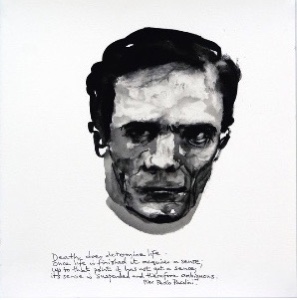
Well before he described the great light of Paradise shining out in all its eschatological glory, Dante decided to reserve a quiet but significant fate, in the twenty-sixth canto of the Inferno, for the “tiny light” of those glowing worms, the fireflies. The poet is observing the eighth bolgia of hell, a political bolgia if ever there was one, since we can recognize a few eminent citizens of Florence gathered there, among others, all under the same condemnation as evil counselors. The entire space is scattered—constellated, infested—with small flames that look like fireflies, just like those that people see…
Michael Löwy | Incandescent Flame: Surrealism as a Romantic Revolutionary Movement
What is romanticism? Often it is reduced to a nineteenth century literary school, or to a traditionalist reaction against the French Revolution—two propositions found in countless works by eminent specialists in literary history and the history of political thought. This is too simple a formulation. Rather, Romanticism is a form of sensibility nourishing all fields of culture, a worldview which extends from the second half of the eighteenth century to today, a comet whose flaming “core” is revolt directed against modern industrial civilization, in the name of some of the social and cultural values of the past. Nostalgic for…
Sergei Tret’iakov | Art in the Revolution and the Revolution in Art (Aesthetic Consumption and Production)
Tret’iakov published the following essay in the Proletkul’t journal Gorn [The Forge] during a period of close collaboration with the mass organization’s Moscow group, where he held leading positions in both its theatrical and literary divisions. The text explores a variant of Lef production art that has been reconjugated using the theories of one of Proletkul’t’s founders, the scientist, author, and cultural theoretician Aleksandr Bogdanov. Even though Bogdanov had been forced from the political stage by the early 1920s and consequently could not be mentioned by name in Tret’iakov’s “Art in the Revolution,” the 1923 essay is nevertheless Bogdanovite…
Peter Bouscheljong | der traum von einer sache [subversive chronik]
Furio Jesi | The Suspension of Historical Time
Andrea Cavalletti The text we are presenting here, “The Suspension of Historical Time,” is drawn from the book Spartakus: Simbologia della rivolta, which Furio Jesi wrote between 1968 and 1969. Jesi was born into a partly Jewish family in Turin in 1941 and died in Genoa in 1980; despite this early demise, he was one of twentieth-century Italy’s most important and original thinkers and essayists. A true enfant prodige, he got his start as an Egyptologist when he was barely fifteen. In the early 1960s, he turned to the study of mythology and the science of myth, or rather,…
Georges Didi-Huberman | The Supposition of The Aura: The Now, The Then and Modernity (Walter Benjamin)
Walter Benjamin and History Edited by Andrew Benjamin Continuum 2005
riots and/or poetics [5/2021]
Thus ’77 saw a flaring up, a quotidian generalization of a political and cultural conflict with ramifications for every part of society, exemplifying a conflict that had taken place throughout the 1970s, a fierce conflict both between classes and within the class, perhaps the fiercest seen since the Unification of Italy. Forty thousand criminal charges, 15,000 arrests, 4,000 people sentenced to a thousand years of prison—and then there were the deaths and the hundreds of wounded on both sides. There is no doubt that these figures cannot be considered merely the result of some risky, crazy plan dreamt up by…
Carla Lonzi’s Self-Portrait | A conversation with Allison Grimaldi Donahue & Teresa Kittler
In 1969, the Italian art critic and feminist Carla Lonzi (1931-1982) authored Autoritratto (Self-Portrait) using the transcripts of interviews conducted with fourteen prominent artists living in Italy: Carla Accardi, Getulio Alviani, Enrico Castellani, Pietro Consagra, Luciano Fabro, Lucio Fontana, Jannis Kounellis, Mario Nigro, Giulio Paolini, Pino Pascali, Mimmo Rotella, Salvatore Scarpitta, Giulio Turcato and Cy Twombly. Overlooked for many years, Autoritratto’sexperimental unravelling of traditional art criticism has garnered increasing attention since its republication by Et al./Edizioni in 2010. It was, however, Lonzi’s final work as an art critic; after its publication she renounced the art world, co-founded the collective Rivolta femminileand wrote a…
riots and/or poetics [1/2021]
A Reading List Galina Rymbu | Life in Space (Ugly Duckling Presse). Can poetry be a revolutionary practice? Under what conditions can poetry trigger change? In All The King’s Men, Guy Debord states: “The point is not to put poetry at the service of revolution, but to put revolution at the service of poetry.” As a political activist, Rymbu participated in the 2011-12 protests for fair elections during her time at the Moscow Gorky Literature Institute. The street is still the place where the anti-capitalist fights, the struggles for a better life take place. The poems of the cycle White…
Keston Sutherland | The poetics of ‘Capital’
A year before the first English edition of Capital was published under his supervision in 1886, Engels issued a brief polemic against the pretensions of anyone reckless enough to think that this great work could be translated into English by a mere amateur man of letters. The target of the polemic is Henry Mayers Hyndman, identified in the essay by his pseudonym John Broadhouse. After reading the French translation of Capital in 1880, Hyndman had published in 1881 a short book, England for All, two chapters of which were so thoroughly plagiarized from Marx’s work that they in effect…
ANNOUNCING TRIPWIRE PAMPHLET #8: PETER BOUSCHELJONG | THE PROCESSES, A FACTOGRAPHICAL PROEM
Announcing Tripwire Pamphlet #8: The Processes, a factographical proem, by Peter Bouscheljong, translated by David Vichnar, Louis Armand & Tim König. A dialectical poetics of radical history that asks what kind of resistance and poetry is possible under conditions of capitalist repression, if we do not simply want to return to everyday life? Synthesizing documentary poetics (the lives of George Jackson, Luxemburg, Verlaine, Pasolini, Anna Mendelssohn, Dalton, Vallejo, and others) with the capitalist alchemy of surveillance and repression, the long “proem” tracks the processes with which those in power react to the social struggles of political movements and the works of revolutionary poets, who strike back into a…
Nathalie Wourm | Poetic Sabotage and the Control Society: Christophe Hanna, Nathalie Quintane, Jean-Marie Gleize
Parallels can be drawn between Gilles Deleuze and Félix Guattari’s concept of “minor literature” and the artistic practice of a number of contemporary French writers, whose works do not only represent the voicing of their political contentions, but also act as verbal objects designed to undermine the mainstream idea of what literature is and should be. [..] Christophe Hanna, Nathalie Quintane, and Jean-Marie Gleize are three authors who share a number of theoretical ideas and political references and have been expressing their opposition to the system in this way.
Jacques Rancière & Philippe Lafosse | Politics and Aesthetics in the Straubs’ Films
Jacques Rancière, Philippe Lafosse and the public in conversation about Straub-Huillet after a screening of From the Clouds to the Resistance and Workers, Peasants Monday, February 16, 2004, Jean Vigo Cinema, Nice, France PHILIPPE LAFOSSE: It seemed interesting to us, after having seen twelve films by Jean-Marie Straub and Danièle Huillet and talked about them together, to ask another viewer, a philosopher and cinephile, to talk to us about these filmmakers. Jacques Rancière is with us this evening to tackle a subject that we’ve entitled “Politics and Aesthetics in the Straubs’ Films,” knowing that we could then look into other…
Georges Didi-Huberman | Light against Light
The disappearance of the fireflies—when the blinding glare of spotlights crushes the weak glimmer of glowworms in the night—is an excellent poetic allegory, a lovely “speaking image” on which to build something like a general poetics of light. This allegory has become familiar to us through the intervention of a great poet, Pier Paolo Pasolini.1 So we cannot be surprised that artists and thinkers have elevated this allegory in the field of aesthetics, and that it may lend itself as the title of an art exhibit. And yet its sole purpose is to ask, stubbornly, over and over…
Nanni Balestrini | “I write to you opposite the balcony from whence I contemplate the eternal light whose radiant fire slowly fades on the distant horizon”
At one point in ‘Blackout’, Balestrini writes, “This poem should not be published because it is a political manifesto.” The historical events with which ‘Blackout’ is concerned and toward which it is critical began with the wave of conflicts in 1968 at the universities and factories and eventually spread throughout the West. The protests culminated in the “troubled autumn” of 1969, eventually involving the entire Italian working class in strikes, demonstrations, and acts of sabotage.
Carla Lonzi (Part One)
Karolin Meunier ON VAI PURE BY CARLA LONZI READING SESSION 1 AND 2. EDIT 2 How to introduce a book that I hardly know, written in a language that I do not speak? The following text is the product of two translation sessions, one with Paolo Caffoni and one with Federica Bueti, as we started to read Vai Pure (Now You Can Go), a conversation between the Italian feminist, writer, and art historian Carla Lonzi and her partner Pietro Consagra, conducted in Lonzi’s apartment in Rome 1980 before they broke up their relationship. Lonzi had used this method—that is…
Carla Lonzi (Part Two)
FINDING RESONANCES WITH CARLA LONZI Giovanna Zapperi with Federica Bueti I am not quite sure when or how I came across Carla Lonzi’s writing. It happened in the casual manner in which sometimes one’s life changes in unexpected ways. Lonzi’s writing did not change my life, but it offered me an opportunity to reflect upon it. Lonzi’s feminist practice is a work of unearthing, undoing, and undressing that shakes up the foundation of our culture and beings. What has society made of me? Who am I? Lonzi ceaselessly questions her sense of self, the place society had assigned to…
Félix Guattari | Militant Incidences
1 On the Question of “Primordial Bureaucratic States”1 Since you have asked me to elaborate on my thoughts about stylites and other dendrites, I will take a stab at laying out some of the connections here. Mystics—Coptics, Syrians and other, express their desire to return to the roots, the roots of the primordial Empire: the Ur-State (there is a wordplay like this in the book by Lacarrière).2 In their own way, they’re championing the Asiatic State. The Egyptians and the sons of Trojan warriors never could take being fucked with and eliminated by barbarians and pirates like the Greeks,…
Jacques Rancière | The Fraternal Image; interviewed by Serge Daney & Serge Toubiana
Originally published as ‘L’Image Fraternelle‘, Cahiers du Cinéma, nos. 268-269, part of a special issue dedicated to “Images de Marque” (July-August 1976). Source: Diagonal Thoughts Cahiers: If we consider two films, ‘Milestones’ (Robert Kramer & John Douglas) and ‘Numéro Deux’ (Jean-Luc Godard & Anne-Marie Miéville), it seems to us that the first has a genealogical dimension that is completely absent in the second. We could say that ‘Milestones’ has a place in a history of “genres” (American cinema) while ‘Numéro Deux’ has a place in a history of “forms” (European cinema). The result is that ‘Milestones’, but perhaps…
The Power of Political, Militant, ‘Leftist’ Cinema. Interview with Jacques Rancière
By Javier Bassa Vila Jacques Rancière’s thought is undisciplined, at least in two different but interlinked senses. On the one hand, in the 1970s Rancière suggested a reading of Marxism that broke with the dominant interpretations of the time, specially with the scientifist Marxism imposed by Althusser (see La leçon d’Althusser, originally published in 1976 and re-published in 2012 by La Fabrique – and due to come out soon in Spanish). On the other hand, the broad interest that his thought has triggered at an international level seems to be also the consequence of another in-discipline: his reflections are…
Jacques Rancière | Circuit Rounds and Spirals [from ‘Proletarian Nights’]
ANOTHER FEVER, ANOTHER EXILE. This printer has gone back out the door he just entered: “On the fifth day we got the sinister message—nothing more to do!”1 These mishaps are frequent in the typographer’s trade, one marked by the singular fact that a day at work is not necessarily a day of work: “It is pretty much only in the printshop that one is permitted the revolting and wicked abuse of hiring people and keeping them behind bars or under lock and key, without feeling obliged to give them any work or remuneration.”2 That is the lot of the…
Sergei Eisenstein | Notes for a Film of ‘Capital’
October 12, 1927. It’s settled: we’re going to film CAPITAL, on Marx’s scenario—the only logical solution. N.B. Additions . . . those are clips pasted to the wall of montage. October 13, 1927. . . . To extend the line (and to explicate it, step by step) of dialectical development in my work. Let us recall: 1. STRIKE. The order—educational and methodological film on the methods and processes of class and of underground work. Whence—serial film structure and detachment from a specific place (in the project there’s a whole series of escapes, prison life, rebellion, body-searchers, etc.). 2. POTEMKIN. I’m emphasizing,…
Mehdi Belhaj Kacem, Philippe Sollers | What is the Meaning of the Avant-garde’s Death?
FIRST PUBLISHED: DIAPHANES How could Dante be avant-garde? Mehdi Belhaj Kacem: Mr. Sollers, for 23 years you were the editor of Tel Quel, doubtless the very last important literary review that can be considered “avant-garde.” It published some of the biggest “avant-garde” writers of its time, like Pierre Guyotat, Maurice Roche, Jean-Jacques Schuhl and yourself, as well as still-unknown academics like Jacques Derrida, Roland Barthes and Gérard Genette. You also published Pierre Boulez and Jean-Luc Godard, who, like the writers and thinkers I just mentioned, were the leading avant-garde figures in their respective fields. In 1983 you left Les Éditions du Seuil,…
Walter Benjamin | The Author as Producer
II s’agit de gagner les intellectuels “la classe ouvriere, en leur faisant prendre conscience de l’identité de leurs de-marches spirituelles et de leurs conditions de producteur. – Ramon Fernandez You recall how Plato treats the poets in his projected State. In the interest of the community, he does not allow them to live there. He had a high idea of the power of poetry. But he considered it destructive, superfluous – in a perfect community, needless to say. Since then, the question of the poet’s right to exist has not often been stated with the same insistence;…
Devin Fore | Soviet Factography: Production Art in an Information Age (Sergei Tret’iakov)
If facts destroy theory, then all the better for theory. —Viktor Shklovsky, “In Defense of the Sociological Method,” 1927 Any discussion of factography first has to deal with the conspicuous strangeness of the word “factography” itself, an awkward and selfconsciously technicist term coined in Russia in the latter half of the 1920s to designate a certain aesthetic practice preoccupied with the inscription of facts. Those who are familiar with contemporaneous avant-garde movements in other countries and who may also be skeptical of the early Soviet zeal for linguistic invention will wonder if factography is not simply another word…
Pasolini on de Sade: An Interview during the Filming of ‘Salò or the 120 Days of Sodom’
by Gideon Bachmann It is reputed that Donatien Alphonse François, Marquis de Sade, spent only 37 days, writing from seven to ten every evening, in composing his masterpiece, the unsurpassed 120 Days of Sodom, the first psychopathia sexualis ever written, and preserved only in fragmentary form. More than half of what has been left are just lists of perversions, lacking that deep sociological and political insight which characterizes most of the Marquis’s other work, and which assured him his ranking place in prerevolutionary French literature. Nobody has ever used a de Sade book as material for a film. It is therefore all…
Roland Barthes | Sade – Pasolini
SALÒ does not please fascists. On another side, since Sade has become for some of us a kind of precious patrimony, many cry out: Sade has nothing to do with fascism! Finally, the remainder, neither fascist nor Sadean, have an immutable and convenient doctrine that finds Sade boring. Pasolini’s film therefore can win no one’s adherence. However, quite obviously, it hits us somewhere. Where? In SALÒ, what touches is the letter. Pasolini has shot his scenes to the letter, the way that they had been described (I do not say “written”) by Sade; hence these scenes have the sad, frozen and rigorous beauty…
Harun Farocki | Peter Weiss On Display (The Aesthetics of Resistance)
We were visiting Peter Weiss in Stockholm on 17th and 18th June 1979. We talked about his work on the book The Aesthetics of Resistance. Two volumes have already been published and P.W. is currently on the third. He has been working on it for over ten years and not one sentence is unfounded. Weiss has performed an unbelievable amount of research, studied the lives of people serving as models down to the tiniest detail, and attaches great importance to visiting the scenes of the action. The film gives an impression of his work. Harun Farocki, 1979 Harun Farocki:…
Mark Fisher | We Need a Post-Capitalist Vision | Interviewed by AntiCapitalist Initiative
AntiCapitalist Initiative : Paul Mason recently argued that in light of the Arab revolutions, capitalist realism has come to an end. 2 Do you agree? Mark Fisher : I think that is going too far. I understand why Paul made that claim, but capitalist realism is very tenacious. Certainly, things look very different to how they did a few years ago during the high pomp of capitalist realism — when it was thought that the age of revolutions was in the past, that no great change will ever happen again, that every part of the world will eventually end up…
Mark Fisher | Hauntology, Nostalgia and Lost Futures | Interviewed by V. Mannucci & V. Mattioli
When, a bit over a year ago, we had the pleasure of meeting with British writer and theorist Mark Fisher in Rome, his book Ghosts of My Life: Writings on Depression, Hauntology and Lost Futures was about to come out and we took the opportunity in order to talk with him about the future — not about his future or our future, but about the idea of the future itself in present-day society. Now with the lapse of time, then, one might ask wether it is still an interview about the future or rather about the past. According to the perspective discussed below,…
Mark Fisher | Acid Communism (Unfinished Introduction)
“The spectre of a world which could be free” “[T]he closer the real possibility of liberating the individual from the constraints once justified by scarcity and immaturity, the greater the need for maintaining and streamlining these constraints lest the established order of domination dissolve. Civilisation has to protect itself against the spectre of a world which could be free. […] In exchange for the commodities that enrich their lives […] individuals sell not only their labour but also their free time. […] People dwell in apartment concentrations — and have private automobiles with which they can no longer escape…
Farocki / Godard: Film as Theory; by Volker Pantenburg
Farocki / Godard | Film as Theory PDF Volker Pantenburg There is a tension between the requirements of theoretical abstraction and the capacities of the film medium, where everything that we see on screen is concrete: A train arriving at a station, a tree, bodies, faces. Since the complex theories of montage in Soviet cinema, however, there have continuously been attempts to express theoretical issues by combining shots, thus creating a visual form of thinking. This book brings together two major filmmakers-French New Wave master Jean-Luc Godard and German avant-gardist Harun Farocki to explore the fundamental tension between theoretical abstraction…
The Invisible Committee | Now
‘Now’ proposes a “destituent process” that charts out a different path to be taken, a path of outright refusal that simply ignores elections altogether. It is a path that calls for taking over the world and not taking power, for exploring new forms of life and not a new constitution, and for desertion and silence as alternatives to proclamations and crashes. It is also a call for an unprecedented communism—a communism stronger than nation and country.
Kristin Ross | Against commemoration: Unearthing the lives and afterlives of May ’68
Thread:In May ’68 and its afterlives (2002), you described France’s ‘68 as a “union of intellectual contestation with workers struggles.” Left formations today struggle to create programs of action that unite peoples of different sectors of society. What should the Left know about the political struggles that unfolded in May 1968 in France? What thought and action enabled the coalescence of forces in ‘68? Ross: Well, that changes all the time, doesn’t it? The past is very unpredictable and its ability to connect with our current situations is often indirect and somewhat aleatory. When I wrote my book, for example, at…
Gilles Deleuze | Postscript on the Societies of Control
1. Historical Foucault located the disciplinary societies in the eighteenth and nineteenth centuries; they reach their height at the outset of the twentieth. They initiate the organization of vast spaces of enclosure. The individual never ceases passing from one closed environment to another, each having its own laws: first, the family; then the school (“you are no longer in your family”); then the barracks (“you are no longer at school”); then the factory; from time to time the hospital; possibly the prison, the pre-eminent instance of the enclosed environment. It’s the prison that serves as the analogical model: at the…
Gilles Deleuze | Control and Becoming
Negri: The problem of politics seems to have always been present in your intellectual life. Your involvement in various movements (prisoners, homosexuals, Italian autonomists, Palestinians), on the one hand, and the constant problematizing of institutions, on the other, follow on from one another and interact with one another in your work, from the book on Hume through to the one on Foucault. What are the roots of this sustained concern with the question of politics, and how has it remained so persistent within your developing work? Why is the relation between movement and institution always problematic? Deleuze: What I’ve been interested in…
Jacques Rancière | Staging the People
Jacques Rancière | Staging the People The Proletarian and His Double PDF These essays from the 1970s mark the inception of the distinctive project that Jacques Rancière has pursued across forty years, with four interwoven themes: the study of working-class identity, of its philosophical interpretation, of “heretical” knowledge and of the relationship between work and leisure. For the short-lived journal Les Révoltes Logiques, Rancière wrote on subjects ranging across a hundred years, from the California Gold Rush to trade-union collaboration with fascism, from early feminism to the “dictatorship of the proletariat,” from the respectability of the Paris Exposition to…
Harun Farocki / Kaja Silverman | Speaking about Godard
Kaja Silverman and Harun Farocki Speaking about Godard Full book / PDF “Probably the most prominent living filmmaker, and one of the foremost directors of the postwar era, Jean Luc-Godard has received astonishingly little critical attention in the United States. With Speaking about Godard, leading film theorist Kaja Silverman and filmmaker Harun Farocki have made one of the most significant contributions to film studies in recent memory: a lively set of conversations about Godard and his major films, from Contempt to Passion. Combining the insights of a feminist film theorist with those of an avant-garde filmmaker, these eight dialogues–each representing…
Italy 1977-8: Living with an earthquake – Red Notes
Italy 1977-8: Living with an earthquake – Red Notes A pamphlet from a time when a very high level of class struggle dominated Italian society. Despite their differences – the state, church, fascists, Communist Party and unions were all united in opposition to the the radical social movement. A. Preface We have called our pamphlet “Living With An Earthquake”. This earthquake is not just the crisis at Government level – it is a quite new political upheaval affecting the whole of Italian society. We have produced this pamphlet because it is vitally important that the outside world should…
Jean-Luc Godard | What is to be done? // British Sounds, by J.-L. Godard [DVG]
Written in January 1970 at the request of Simon Field and Peter Sainsbury for the magazine Afterimage, produced by Peter Whitehead. Published in Afterimage n°1, April 1970. Translated from French by Mo Teitelbaum. We must make political films. We must make films politically. 1 and 2 are antagonist to each other and belong to two opposing conceptions of the world. 1 belongs to the idealistic and metaphysical conception of the world. 2 belongs to the Marxist and dialectical conception of the world. Marxism struggles against idealism and the dialectical against the metaphysical. This struggle is the struggle between the…
Maurizio Lazzarato | Marcel Duchamp and The Refusal of Work
MARCEL DUCHAMP AND THE REFUSAL OF WORK PDF MAURIZIO LAZZARATO Art, work and politics in disciplinary societies and societies of security According to Michel Foucault, for some time we have been leaving disciplinary societies in order to enter into societies of security that, unlike the former, ‘tolerate a whole host of behaviours that are different, varied, or even deviant and antagonistic toward one another’. [1] These societies lead us beyond disciplines, because they put in place policies regarding the government of conducts that are exercised through the management of heterogeneities and the ‘optimization of systems of differences’ – that…
Tiqqun | This Is Not a Program
“’77 wasn’t like ’68. ’68 was anti-establishment, ’77 was radically alternative. This is why the ‘official’ version portrays ’68 as good and ’77 as bad; in fact, ’68 was co-opted whereas ’77 was annihilated. This is why, unlike ’68, ’77 could never make for an easy object of celebration.”
— Nanni Balestrini, Primo Moroni, L’orda d’oro
Ralph Rumney | The Consul
Ralph Rumney | The Consul PDF Ralph Rumney has been in constant flight from the wreckage of postwar Europe. Crossing paths with every avant-garde of the past fifty years, he was one of the founding members of the Situationist International. Rumney’s traveling companions — Guy Debord, Pegeen Guggenheim, Asger Jorn, Michèle Berstein, Bernard Kops, Yves Klein, Marcel Duchamp, Georges Bataille, William Burroughs, Félix Guattari, E.P. Thompson, Victor Brauner, and many others — are recalled in the oral history with sharp intelligence and dry wit. The Consul: Contributions to the History of the Situationest International and Its Time…
Mark Fisher; The Weird And The Eerie
Mark Fisher; The Weird And The Eerie (Full book) Eugene Thacker – Weird, Eerie, and Monstrous: A Review of “The Weird an the Eerie“ by Mark Fisher For a long time, the horror genre was not generally considered worthy of critical, let alone philosophical, reflection; it was the stuff of cheap thrills, pulp magazines, B-movies. Much of this has changed in the ensuing years, as a robust and diverse critical literature has emerged around the horror genre, much of which not only considers the horror genre as a reflection of society, but as an autonomous platform for posing far-reaching questions…
Mark Fisher; Ghosts Of My Life
Mark Fisher; Ghosts Of My Life (Full book) Do you miss the future? Mark Fisher interviewed In 2002, on the band’s debut single Losing My Edge, LCD Soundsystem frontman James Murphy sang of “borrowed nostalgia for the unremembered ’80s”. With that line he playfully skewered the Brooklynite hipsters in “little jackets” whose instinct to look back to pop’s golden past, instead of forward, exemplified a creeping revivalism and dearth of innovation. As electronic music stumbled into the background to become the banal Eurodance backing track for the noughties pop star, or dived underground to simmer (dubstep/grime), rock went retro with the…
Mark Fisher; Capitalist Realism | Is There No Alternative?
Mark Fisher; Capitalist Realism (Full book) Questioning Capitalist Realism: An Interview with Mark Fisher Mark Fisher is the author of Capitalist Realism: Is There No Alternative? out recently from Zer0 Books. As a blogger he writes K-Punk. Capitalist Realism is one of the most acute diagnoses of contemporary politics as it is played out in one small island off the coast of Europe. After skewering the marketisation of everything, the privatisation of stress, and the triumphalism of moronic bureaucracy as the guiding principles of governance, the book goes on to speculate about new forms of politics and culture. In doing…
Gilles Deleuze & Félix Guattari | May ’68 Did Not Take Place
In historical phenomena such as the revolution of 1789, the Commune, the revolution of 1917, there is always one part of the event that is irreducible to any social determinism, or to causal chains. Historians are not very fond of this point: they restore causality after the fact. Yet the event itself is a splitting off from, a breaking with causality; it is a bifurcation, a lawless deviation, an unstable condition that opens up a new field of the possible. In physics, Ilya Prigogine spoke of states in which the slightest differences persist rather than cancel themselves out, and…
Kristin Ross; May ’68 and its Afterlives
Kristin Ross; MAY ’68 AND ITS AFTERLIVES (Full book) During May 1968, students and workers in France united in the biggest strike and the largest mass movement in French history. Protesting capitalism, American imperialism, and Gaullism, 9 million people from all walks of life, from shipbuilders to department store clerks, stopped working. The nation was paralyzed—no sector of the workplace was untouched. Yet, just thirty years later, the mainstream image of May ’68 in France has become that of a mellow youth revolt, a cultural transformation stripped of its violence and profound sociopolitical implications. Kristin Ross shows how the current…