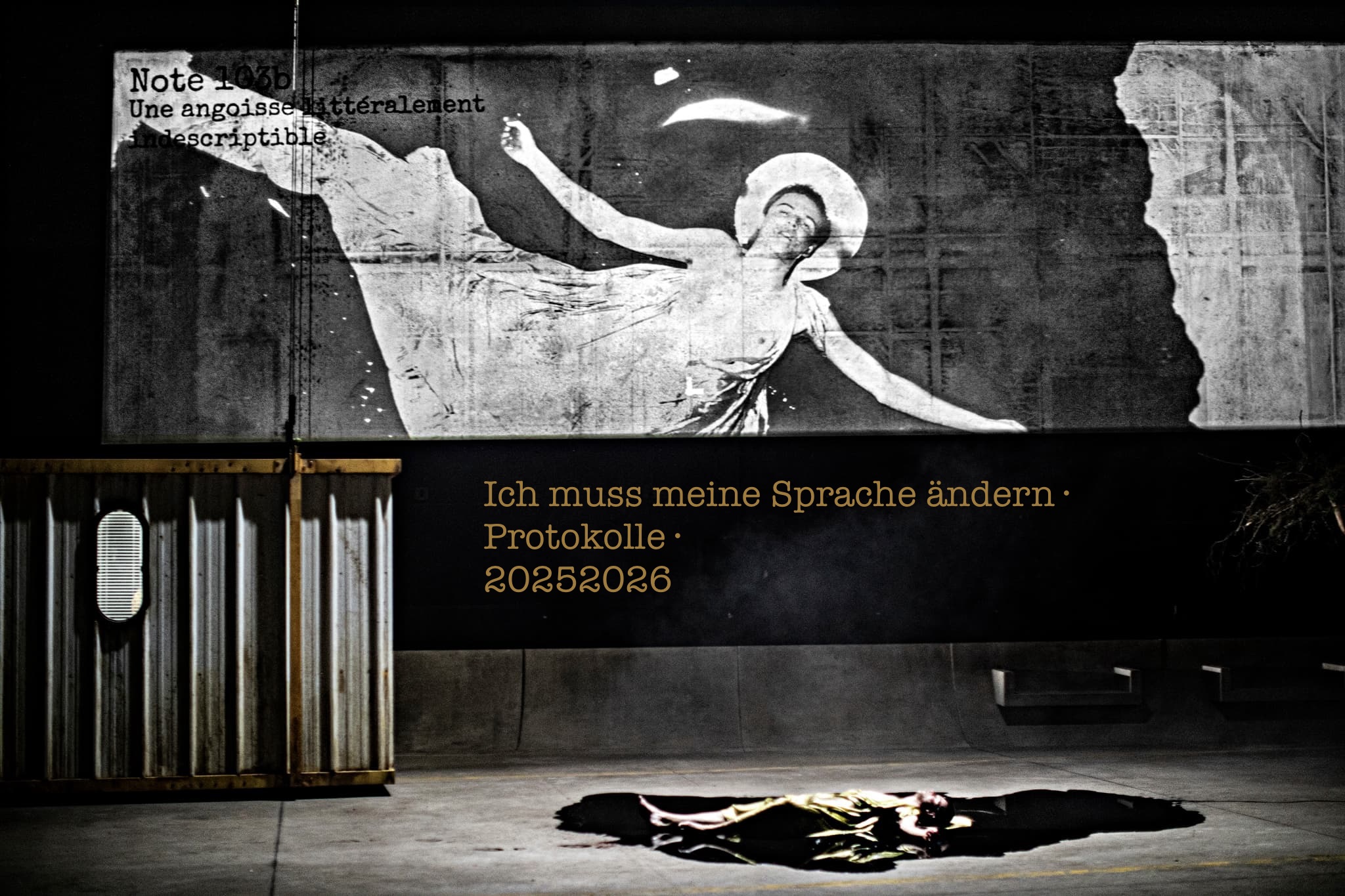

AFTER THE FLOOD After the idea of the Flood had receded, A rabbit rested within swaying clover and bellflowers, saying his prayers to a rainbow spied through a spider’s web. Oh what precious stones sunk out of sight, what flowers suddenly stared. On the dirty main drag it was back to business; ships went to sea, piled on the water like a postcard. Blood flowed—at Bluebeard’s, in slaughterhouses, in circuses— wherever God’s mark marred windows. Milk and blood flowed. Beavers dammed. Steam rose from coffee cups in small cafés. The mansion’s windows were still streaming, mourning children within contemplating amazing…
Peter Bouscheljong | RIMBAUD FABRIK / 2
»Alle Bürger sind nämlich, genau betrachtet, Rassisten, gleichgültig, wann und wo, gleichgültig, welcher Partei sie angehören.« Pier Paolo Pasolini (Lutherbriefe) macht euch nichts vor :: ich bin ein Tier, gehöre nicht zu eurer Rasse, betäubt vom tödlichen Glanz der Städte, den impassiblen Routen des Calais-Dschungels :: erbaut in den Demenzen & Delirien goldener Jahrhunderte aus Kartons und Krätze und abgezählten Sargnägeln ah, ich sah die Schuppen des Ungeziefers in menschlicher Gestalt, das Weiß der Augen, die große Narbe blutgestillter Nächte, auf meiner Stirn die schabenden Hände um sich selbst kreisender künstlicher Intelligenzen / die in bürgerlichen Laboratorien erzeugten Seinsweisen …
Raúl Zurita | The Sea
Strange baits rain from the sky. Surprising bait falls upon the sea. Down below the ocean, up above unusual clouds on a clear day. Surprising baits rain on the sea. There was a love raining, there was a clear day that’s raining now on the sea. They are shadows, bait for fishes. A clear day is raining, a love that was never said. Love, ah yes, love, amazing baits are raining from the sky on the shadow of fishes in the sea. Clear days fall. Some strange baits with clear days stuck to them, with loves that…
Roger Gilbert-Lecomte | Necessity of Revolt: The Power of Renunciation
That’s agreed then. Tabula rasa: everything is true — there is nothing else. The great vertigo of Revolt has sent the phantasmagoria of appearances reeling and tumbling. Illusion shredded, the material world deforms, reforms, appears and disappears at the mercy of the rebel. A black gulf now swirls in place of what was the self, consciousness, the autonomy of the individual. His rolled-back eyes look between strained temples to where a vast, empty steppe stretches out, barred at the horizon by the floes of the old, bleached senses. He who has renounced everything outside himself just as he has…
Nanni Balestrini | “I close my eyes and start to sing”
NANNI BALESTRINI (1935-2019) I close my eyes and start to sing threads are entangled and transformed into spots whose dance moves ever more slowly I sang my repertoire then I started monologues with my eyes closed I walked back and forth in the cell four steps forward four steps back I invented dialogues for two characters that spoke different languages like at the cinema when the film ends there are those who make love who smoke there are those who merely exist Nanni Balestrini, the radical Italian experimental visual artist, poet, and novelist known for recombinatory, revolutionary…
Peter Bouscheljong | RIMBAUD FABRIK / 1
O Märchen in Fabriken grau versperrt! Georg Trakl Stoß ich auch, was geht’s mich an, an Grenzen, die ich einst beschwor, Ordnungen stürzen, faulende Gesetze, das Selbst-Mitleid von Nationen, die angedachte Flaute vor dem Verfall gärt schwärzlich vor sich hin, doch die Irr- und Wirrsal-Niederschläge steh ich durch, wer zeigte dir, so überheblich zu sein, gegen jede Strömung, kurz bevor du nachts um drei die letzte Zweideutigkeit lebtest, die Wiege meiner Erniedrigung — der Vogel-Schiss liegt klar in eurem Feld Schluss mit den Spektakeln, von Saison zu Saison, ich vermisse nichts — ach ja, die Sehnsucht nach guten Dichtern mit…
Jean-Luc Godard’s “Militant Filmmaking”; by Irmgard Emmelhainz
Irmgard Emmelhainz | Between Objective Engagement and Engaged Cinema: Jean-Luc Godard’s “Militant Filmmaking” (1967–1974) It is often argued that between 1967 and 1974 Godard operated under a misguided assessment of the effervescence of the social and political situation and produced the equivalent of “terrorism” in filmmaking. He did this, as the argument goes, by both subverting the formal operations of narrative film and by being biased toward an ideological political engagement.1 Here, I explore the idea that Godard’s films of this period are more than partisan political statements or anti-narrative formal experimentations. The filmmaker’s response to the intense political climate that…
Sean Bonney | Letters Against the Firmament
I haven’t written for a while, I know. There’s not been much to write about, or maybe, if there has been I haven’t seen it. That’s leaving aside, of course, the royal birth, the jubilee pageants and the olympics, that inbred panegyric. Christ, I’ve really felt the wings of imbecility passing over me lately, over all of us. Its as if the ruling class, sheer power, whatever you want to call it, whatever it’s local franchise likes to call itself, had, via some kind of sadistic alchemy, taken the moment (around 2 in the afternoon) on 27th March 2011…
Peter Bouscheljong | Kleine Poetik des Aufstands (Erstes Manifest)
Das gegenwärtige Frankreich versetzt mir einen Schwindel, aber einen, der in Ekel gekleidet ist. Paris und sein elegantes Gesindel, mit seinen parfümierten und gemeinen Ratten, halte ich nicht aus. René Char 1. im Winter 2018 steigen wir in den Zug nach Paris — was uns erwartet ist ungewiss — aber die Bilder zerschlagener Schaufenster, Feuer in der Banque de France und ein zorniger Christophe Dettinger, kurz: Paris in Flammen, erscheinen uns Nacht für Nacht in unseren Träumen in einer Welt, die in immer kürzeren Zyklen auseinanderfällt ist nichts handlicher als ein Buch oder eine Waffe (das Archiv eine…
Katerina Gogou | Sui generis
Look how the streets disappear amid people… how the kiosks get cold from the wet newspapers the sky how it is punctured by the wires and the end of the sea by the weight of the ships how sad the forgotten umbrellas are at the last bus and the mistake of the one that got off one stop too early the clothes left in the laundry and your shame two years after you made money and found out how to ask for it how bit by bit slowly, methodically it twists us to determine our stance on life by…
Mark Fisher | We Need a Post-Capitalist Vision | Interviewed by AntiCapitalist Initiative
AntiCapitalist Initiative : Paul Mason recently argued that in light of the Arab revolutions, capitalist realism has come to an end. 2 Do you agree? Mark Fisher : I think that is going too far. I understand why Paul made that claim, but capitalist realism is very tenacious. Certainly, things look very different to how they did a few years ago during the high pomp of capitalist realism — when it was thought that the age of revolutions was in the past, that no great change will ever happen again, that every part of the world will eventually end up…
Mark Fisher | Hauntology, Nostalgia and Lost Futures | Interviewed by V. Mannucci & V. Mattioli
When, a bit over a year ago, we had the pleasure of meeting with British writer and theorist Mark Fisher in Rome, his book Ghosts of My Life: Writings on Depression, Hauntology and Lost Futures was about to come out and we took the opportunity in order to talk with him about the future — not about his future or our future, but about the idea of the future itself in present-day society. Now with the lapse of time, then, one might ask wether it is still an interview about the future or rather about the past. According to the perspective discussed below,…
Mark Fisher | Acid Communism (Unfinished Introduction)
“The spectre of a world which could be free” “[T]he closer the real possibility of liberating the individual from the constraints once justified by scarcity and immaturity, the greater the need for maintaining and streamlining these constraints lest the established order of domination dissolve. Civilisation has to protect itself against the spectre of a world which could be free. […] In exchange for the commodities that enrich their lives […] individuals sell not only their labour but also their free time. […] People dwell in apartment concentrations — and have private automobiles with which they can no longer escape…
riots and/or poetics [4/2019]
December Journal / 2017 secret idea / of yours / that you / could become a better person / if you read the right books // at the ica fred moten speaks of “battling with identity against / the backdrop of the denial of identity” // yes yes yes // I have to fight against my urge to ascetism and self-sacrifice / but I’m reading about simone weil again – she seems like the / most beautiful / she says, “when you decide something always do what will cost / you the most” // I would like there not to be grants / no crowdfunding / no paperwork to prove your need / no application to decide who…
Velimir Khlebnikov | Collected Works 1/2/3
Collected Works:
1 Letters and Theoretical Writings.
2 Prose, Plays, and Supersagas.
3 Selected Poems.
Velimir Khlebnikov and ‘Displacement’ as Poetics, by Angelina Saule
Vladimir Mayakovsky | Order to the Army of the Arts
Order to the Army of the Arts [1] (1918) Threadbare men of the old brigade bore on about this and that. Comrades! To the barricades! Barricades of minds and hearts. Only those who have burnt their boats are true communists. You can’t just stroll on, you futurists, the Future requires a leap! It’s not enough just to build the engine — you need a head of steam: wheels turn, we’re off. If there’s no music to lead us on, why bother with AC or DC? Pile sound on sound and for the lyrics we’ve some great phonemes in Russian:…
Peter Bouscheljong | DIE AFFÄRE LEBOVICI | PSYCHOGEOGRAPHIE [ACTE XVIII]
Zum Umsturz aller bestehenden Ordnung aufzurufen / Scheint furchtbar. / Aber das Bestehende ist keine Ordnung. // Zur Gewalt seine Zuflucht zu nehmen / Scheint böse. Aber da, was ständig geübt wird, Gewalt ist / Ist es nichts Besonderes. Bertolt Brecht Die ganze Affäre [wie auch der modus operandi] ist geprägt von einem Klima persönlichen Verrats und politischen Hinterhalts: Gérard Lebovici [Herausgeber der Editions Champ Libre, Produzent und Freund Guy Debords] in einer Tiefgarage in der Avenue Foch, Chaillot. Porte Dauphine mit vier Kugeln im Hinterkopf auf dem Vordersitz seines Wagens; Polizei, D.S.T. & Renseignements généraux zeichnen eine…
Bertolt Brecht | The Reader for City Dwellers
1 Cover your tracks Split from your mate at the train station Go into town in the morning with your coat buttoned up Find a place And when your mate knocks, Don’t, oh, don’t open the door Instead Cover your tracks! If you bump into your parents in the city of Hamburg Or anywhere else (for that matter) Pass them like strangers, turn the corner, don’t acknowledge them Pull the hat, which they gave you, over your face Don’t, oh, don’t show your face Instead Cover your tracks! Eat the meat that’s there! Don’t save anything! Enter any…
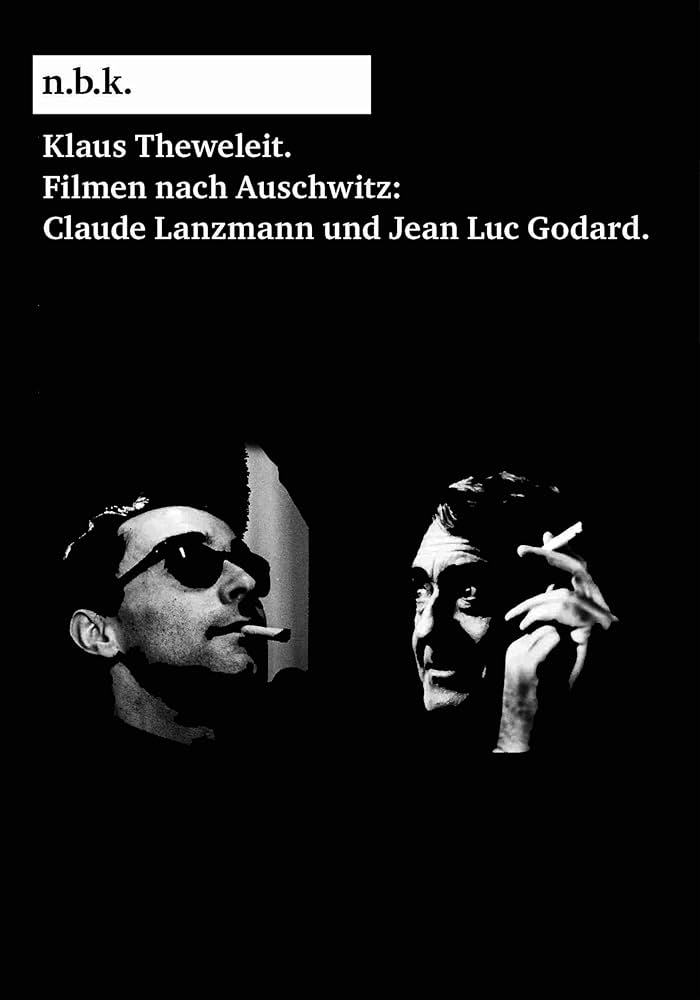
Farocki / Godard: Film as Theory; by Volker Pantenburg
Farocki / Godard | Film as Theory PDF Volker Pantenburg There is a tension between the requirements of theoretical abstraction and the capacities of the film medium, where everything that we see on screen is concrete: A train arriving at a station, a tree, bodies, faces. Since the complex theories of montage in Soviet cinema, however, there have continuously been attempts to express theoretical issues by combining shots, thus creating a visual form of thinking. This book brings together two major filmmakers-French New Wave master Jean-Luc Godard and German avant-gardist Harun Farocki to explore the fundamental tension between theoretical abstraction…
Antonin Artaud
This is the first solo exhibition dedicated to the work of Antonin Artaud to be staged in the UK, and more significantly to focus on the rarely seen notebooks which Artaud began working on from the time of his arrival at the Rodez mental asylum in 1945, until his death at the Ivry clinic in 1948. The eventual 20,000 pages of image-text amalgam constitute one of his most significant bodies of work. An unclassifiable volume of writing and drawing. Portraits, names, calculations, glossolalia, sigils, lists of drugs and foods stuffs, formulae, totems, lexicons, anatomies, objects, (boxes, chains and nails), machines and implements of obscure purpose. There…
Fernand Deligny | The Arachnean and Other Texts
The originality of Deligny’s theoretical and practical position consists precisely in what can be called a “suspension of interpellation,” in which one can also see a fundamental point of intersection with the inaugural gesture of psychoanalysis, over and beyond the explicit oppositions, as will become clear. One might say that to “the theoretical anti-humanism” professed by Althusser, Deligny opposed an authentic “practical anti-humanism” that dismissed “men,” the humans-that-we-are, shored up by what Deleuze called a “thought image” of themselves, a flattering, ready-made image, dominating and exclusive, in favor of a narcissistically and socially less satisfying “human,” possibly mute and idle, but in reality more richly endowed with practical recompositions.
The Invisible Committee | Now
‘Now’ proposes a “destituent process” that charts out a different path to be taken, a path of outright refusal that simply ignores elections altogether. It is a path that calls for taking over the world and not taking power, for exploring new forms of life and not a new constitution, and for desertion and silence as alternatives to proclamations and crashes. It is also a call for an unprecedented communism—a communism stronger than nation and country.
Arthur Rimbaud | The Letters (1870-1872)
TO GEORGES IZAMBARD Charleville, August 25, 1870 Monsieur, How lucky you are to be out of Charleville! In all the world, no more moronic, provincial little town exists than my own. I have no illusions about this any more. Because it is next to Mézières—which no one has heard of—because two or three hundred infantrymen wander its streets, my sanctimonious fellow residents gesticulate like Prudhommesque swordsmen, not at all like those under siege in Metz and Strasbourg! How dreadful, retired grocers donning their uniforms! How marvelous, as though that’s all it takes, notaries, glaziers, tax inspectors, woodworkers, and all…
Antonin Artaud | Alienation and Black Magic & Peter Valente | from “The Artaud Variations”
ALIENATION AND BLACK MAGIC Insane asylums are conscious and premeditated receptacles of black magic, and it is not only that doctors encourage magic with their inopportune and hybrid therapies, it is how they use it. If there had been no doctors there would never have been patients, no skeletons of the diseased dead to butcher and flay, for it is through doctors and not through patients that society began. Those who live, live off the dead. And it is likewise necessary that death live; and there is nothing like an insane asylum for gently incubating death, and for…
Gerald Raunig | For a new political ecosophy [F. Guattari: The Three Ecologies]
‘Three Ecologies’ are Guattari’s political manifesto at the end of a decade he himself called the “winter years.” His interpretation of these years speaks to our present in many ways. Not only does the specter of Donald Trump appear in the text, as cynical actor of speculation, gentrification and the completely unchecked displacement of poorer groups from Manhattan and elsewhere […]
UNE INSULTE À LA REPUBLIQUE: AIMÉ CÉSAIRE AND FRIEDRICH HÖLDERLIN …
UNE INSULTE À LA RÉPUBLIQUE: AIMÉ CÉSAIRE AND FRIEDRICH HÖLDERLIN DECLARE THE FRENCH REVOLUTION A TRAGEDY, VOW TO SUPPORT #GILETSJAUNES MOVEMENT INSTEAD | by H. Bolin I. Introduction The study that follows concerns two tragic plays that treat the emergence and aftermath of a single global revolutionary horizon which included both the French and the Haitian revolutions. As the tragic genre suggests, Friedrich Hölderlin’s The Death of Empedocles (1799) and Aime Césaire’s And the Dogs Were Silent (1956) stage reflections on the initial successes and subsequent defeat of their respective revolutionary moments. What can tragedy or art offer to thinking…
Kristin Ross | Against commemoration: Unearthing the lives and afterlives of May ’68
Thread:In May ’68 and its afterlives (2002), you described France’s ‘68 as a “union of intellectual contestation with workers struggles.” Left formations today struggle to create programs of action that unite peoples of different sectors of society. What should the Left know about the political struggles that unfolded in May 1968 in France? What thought and action enabled the coalescence of forces in ‘68? Ross: Well, that changes all the time, doesn’t it? The past is very unpredictable and its ability to connect with our current situations is often indirect and somewhat aleatory. When I wrote my book, for example, at…
Pragmatic/Machinic: Discussion with Félix Guattari [by Charles J. Stivale]
The following discussion with Félix Guattari took place in his apartment in Paris. With the help of a number of friends, I had prepared a set of questions, and had contacted him to see if he might be available to answer some of them.\1 He responded immediately, and left messages with the friend in Paris in whose apartment I would be staying. Prior to the trip, I also had contacted Gilles Deleuze to arrange an extended interview, and although his schedule and health prevented him from agreeing to a long session, I did visit him at his apartment the…
riots and/or poetics [01/2019]
Since the 17th of November, from the smallest rural village to the largest city, we have risen up against this deeply violent, unjust and unbearable society. We will not let this continue! We rebel against the excessive cost of living, precariousness and misery. We want our loved ones, our families and our children, to live in dignity. 26 billionaires own as much as half of humanity; this is unacceptable. Let’s share the wealth and not the misery! Let’s finish with social inequalities! We demand the immediate increase of wages, social assistance, allowances and pensions, the unconditional right to housing and…
César Vallejo | Cuneiforms
No biographer or scholar can avoid the imprisonment that César Vallejo suffered between November 6, 1920, and February12, 1921, in Trujillo, an episode that stakes out an indubitable before and after in the life and work of the Santiaguino.
The first section of ‘Scales’, ‘Cuneiforms,’ and several poems of ‘Trilce’ were composed in his cell of Trujillo Central Jail. In effect, Vallejo wrote from and about the prison.
Gilles Deleuze | Postscript on the Societies of Control
1. Historical Foucault located the disciplinary societies in the eighteenth and nineteenth centuries; they reach their height at the outset of the twentieth. They initiate the organization of vast spaces of enclosure. The individual never ceases passing from one closed environment to another, each having its own laws: first, the family; then the school (“you are no longer in your family”); then the barracks (“you are no longer at school”); then the factory; from time to time the hospital; possibly the prison, the pre-eminent instance of the enclosed environment. It’s the prison that serves as the analogical model: at the…
Gilles Deleuze | Control and Becoming
Negri: The problem of politics seems to have always been present in your intellectual life. Your involvement in various movements (prisoners, homosexuals, Italian autonomists, Palestinians), on the one hand, and the constant problematizing of institutions, on the other, follow on from one another and interact with one another in your work, from the book on Hume through to the one on Foucault. What are the roots of this sustained concern with the question of politics, and how has it remained so persistent within your developing work? Why is the relation between movement and institution always problematic? Deleuze: What I’ve been interested in…
Guy Debord | Panegyric
“Panegyric means more than eulogy. Eulogy no doubt includes praise of the person, but it does not exclude a certain criticism, a certain blame. Panegyric involves neither blame nor criticism.” LITTRÉ, Dictionnaire de la langue française. “Why ask my lineage? The generations of men are like those of leaves. The wind casts the leaves to the ground, but the fertile forest brings forth others, and spring comes round again. So it is that the human race is born and passes away.” Iliad, Canto VI. I “As for his plan, we profess to be able to demonstrate that there…
Peter Bouscheljong | HERE & ELSEWHERE / HIER UND ANDERSWO
[…] Before she too is slaughtered by the Bourgeois (the mob of order), Rosa Luxemburg writes about Bacchanalia, which the bourgeoisie regularly holds upon its victims. From the perverse happiness of the tormentors: the whispering of the pariahs in secret. Gaps of ghastly proportions. Maintained by continuous police work, by the breeding of greenhouse roses, laws & border installations. The liquidation of the poetic word. Chalk circles one makes around a pair of shoes, a bicycle, a pool of blood [the stigmata of capitalism].
Antonin Artaud | Sylvère Lotringer; All Paranoiacs (Interview with Paule Thévenin)
Antonin Artaud | Post-Scriptum Who am I? Where do I come from? I am Antonin Artaud and if I say it as I know how to say it immediately you will see my present body fly into pieces and under ten thousand notorious aspects a new body will be assembled in which you will never again be able to forget me. Translated by Clayton Eshleman False Witnesses Sylvère Lotringer: You never told me how you met Artaud. Paule Thévenin: No, and I won’t say anything. SL: Ah! It’s a secret. PT: No. People are false witnesses. SL: And you?…
The Invisible Committee | The Coming Insurrection
From whatever angle you approach it, the present offers no way out. This is not the least of its virtues. From those who seek hope above all, it tears away every firm ground. Those who claim to have solutions are contradicted almost immediately. Everyone agrees that things can only get worse. “The future has no future” is the wisdom of an age that, for all its appearance of perfect normalcy, has reached the level of consciousness of the first punks. The sphere of political representation has come to a close. From left to right, it’s the same nothingness striking the…
Jean-Marie Gleize | A Preparatory Act | Insurrection [8th December 2018: Julien Coupat preemptively arrested]
Saturday, 8 December 2018: Julien Coupat preemptively arrested a preparatory act … successive laws has constructed a system of emergency powers which renews the lois scélérates the charge of “criminal conspiracy to commit a terrorist act” it takes only two people to constitute a “terrorist group” and it takes only a preparatory act for the infraction to be so defined. This preparatory act is not specified relation—even tenuous or remote, even love or friendship—with any of the opposed to common law which criminalizes the acts, the antiterrorist approach implicated in a terrorist activity without having to establish a…
Best Books of 2018
Anne Boyer | A Handbook of Disappointed Fate (Ugly Duckling Presse) Leslie Kaplan | Excess — The Factory (Commune Editions) Mark Fisher | K-Punk (Repeater) Bertolt Brecht | The Collected Poems of Bertolt Brecht (W.W. Norton) Wendy Trevino | Cruel Fiction (Commune Editions) Lola Ridge | To the Many (Little Island Press) Auguste Blanqui | The Blanqui Reader | Political Writings (Verso) Jackie Wang | Carceral Capitalism (Semiotext(e)) Roberto Ohrt, Wolfgang Scheppe | The Most Dangerous Game (Merve Verlag) Arthur Rimbaud | Korrespondenz, Briefe, Texte und Dokumente (Matthes & Seitz Berlin) Nathalie Quintane | Un oeil en moins (P.O.L.) Fred…
Jacques Rancière | Staging the People
Jacques Rancière | Staging the People The Proletarian and His Double PDF These essays from the 1970s mark the inception of the distinctive project that Jacques Rancière has pursued across forty years, with four interwoven themes: the study of working-class identity, of its philosophical interpretation, of “heretical” knowledge and of the relationship between work and leisure. For the short-lived journal Les Révoltes Logiques, Rancière wrote on subjects ranging across a hundred years, from the California Gold Rush to trade-union collaboration with fascism, from early feminism to the “dictatorship of the proletariat,” from the respectability of the Paris Exposition to…
PROVOKE: Between PROTEST and PERFORMANCE
The short-lived Japanese magazine Provoke is recognized as a major achievement in world photography of the postwar era, uniting the country’s most contentious examples of protest photography, vanguard fine art, and critical theory of the late 1960s and early 70s in only three issues overall. Provoke is accordingly treated here as a model synthesis of the complexities and overlapping uses of photography in postwar Japan. The writing and images by Provoke’s members – critic Taki Koji, poet Okada Takahiko, photographers Nakahira Takuma, Takanashi Yutaka, Moriyama Daido – were suffused with the tactics developed in some Japanese protest books which made use of innovative graphic design and provocatively “poor” materials. Recording…
Harun Farocki / Kaja Silverman | Speaking about Godard
Kaja Silverman and Harun Farocki Speaking about Godard Full book / PDF “Probably the most prominent living filmmaker, and one of the foremost directors of the postwar era, Jean Luc-Godard has received astonishingly little critical attention in the United States. With Speaking about Godard, leading film theorist Kaja Silverman and filmmaker Harun Farocki have made one of the most significant contributions to film studies in recent memory: a lively set of conversations about Godard and his major films, from Contempt to Passion. Combining the insights of a feminist film theorist with those of an avant-garde filmmaker, these eight dialogues–each representing…
Italy 1977-8: Living with an earthquake – Red Notes
Italy 1977-8: Living with an earthquake – Red Notes A pamphlet from a time when a very high level of class struggle dominated Italian society. Despite their differences – the state, church, fascists, Communist Party and unions were all united in opposition to the the radical social movement. A. Preface We have called our pamphlet “Living With An Earthquake”. This earthquake is not just the crisis at Government level – it is a quite new political upheaval affecting the whole of Italian society. We have produced this pamphlet because it is vitally important that the outside world should…
Jean-Luc Godard | What is to be done? // British Sounds, by J.-L. Godard [DVG]
Written in January 1970 at the request of Simon Field and Peter Sainsbury for the magazine Afterimage, produced by Peter Whitehead. Published in Afterimage n°1, April 1970. Translated from French by Mo Teitelbaum. We must make political films. We must make films politically. 1 and 2 are antagonist to each other and belong to two opposing conceptions of the world. 1 belongs to the idealistic and metaphysical conception of the world. 2 belongs to the Marxist and dialectical conception of the world. Marxism struggles against idealism and the dialectical against the metaphysical. This struggle is the struggle between the…
Maurizio Lazzarato | Marcel Duchamp and The Refusal of Work
MARCEL DUCHAMP AND THE REFUSAL OF WORK PDF MAURIZIO LAZZARATO Art, work and politics in disciplinary societies and societies of security According to Michel Foucault, for some time we have been leaving disciplinary societies in order to enter into societies of security that, unlike the former, ‘tolerate a whole host of behaviours that are different, varied, or even deviant and antagonistic toward one another’. [1] These societies lead us beyond disciplines, because they put in place policies regarding the government of conducts that are exercised through the management of heterogeneities and the ‘optimization of systems of differences’ – that…
Jacques Rancière | The Red of ‘La Chinoise’: Godard’s Politics
How should we understand the politics Godard puts into play with his cinematographic practice in La Chinoise? The opinions on the matter have more or less followed the fluxes and refluxes of the left. Accused when first released of being just a caricature, and not a serious representation, of real militant Maoists, the film was later praised as a brilliant anticipation of the events of May 1968, and as a lucid look both at the passing infatuation with Maoism by bourgeois youngsters and at the outcomes of that infatuation: the return to order and terrorism. The question of whether…
Jacques Rancière | Documentary Fiction: Chris Marker and the Fiction of Memory
The Last Bolshevik is the title of the film Chris Marker dedicates to the memory of Alexander Medvekin, the Soviet filmmaker who was born with his century and who died during the Perestroika. To speak of ‘memory’ is to raise the paradox of the film at the outset. Marker’s film cannot very well hope to preserve the memory of a filmmaker whose films we have not seen and whose name was, until quite recently, unfamiliar to most of us. Nor is this situation much different with Medvekin’s compatriots, who are as likely to know his films as we are. The…
Arthur Rimbaud | A Season in Hell
* * * Long ago, if my memory serves, life was a feast where every heart was open, where every wine flowed. One night, I sat Beauty on my knee. —And I found her bitter. —And I hurt her. I took arms against justice. I fled, entrusting my treasure to you, o witches, o misery, o hate. I snuffed any hint of human hope from my consciousness. I made the muffled leap of a wild beast onto any hint of joy, to strangle it. Dying, I called my executioners over so I could bite the butts of their rifles….
riots and/or poetics [10/2018]
“History is full of people who just didn’t. They said no thank you, turned away, escaped to the desert, lived in barrels, burned down their own houses, killed their rapists, pushed away dinner, meditated into the light. Even babies refuse, and the elderly also. Animals refuse: at the zoo they gaze through Plexiglas, fling feces at human faces. Classes refuse. The poor throw their lives onto barricades, and workers slow the line. Enslaved people have always refused, poisoning the feasts and aborting the embryos, and the diligent, flamboyant jaywalkers assert themselves against traffic as the first and foremost visible daily lesson…
Antonin Artaud | Manifesto In A Clear Language
If I believe neither in Evil nor in Good, if I feel such a strong inclination to destroy, if there is nothing in the order of principles to which I can reasonably accede, the underlying reason is in my flesh. I destroy because for me everything that proceeds from reason is untrustworthy.I believe only in the evidence of what stirs my marrow, not in the evidence of what addresses itself to my reason. I have found levels in the realm of the nerve. I now feel capable of evaluating the evidence. There is for me an evidence in the realm…
Nathaniel Mackey | Cante Moro
I would like to touch on the topic of “The New American Poetry“ where it opens onto matters we wouldn’t necessarily expect it to entail—not necessarily “new,” not necessarily “American,” not even necessarily “poetry.” What I’d like to touch on is the New American Poetry’s Spanish connection: Garcia Lorca’s meditation on the “dark sounds” of cante jondo, deep song, the quality and condition known as duende. I’ll be talking about that in relation to an array of “dark sounds” which bear upon a cross-cultural poetics intimated by the inclusion of Lorca’s “Theory and Function of the Duende” in The Poetics…
Arthur Rimbaud | Poems 1871/72
STOLEN HEART My sad heart drools on deck, A heart splattered with chaw: A target for bowls of soup, My sad heart drools on deck: Soldiers jeer and guffaw. My sad heart drools on deck, A heart splattered with chaw! Ithyphallic and soldierly, Their jeers have soiled me! Painted on the tiller Ithyphallic and soldierly. Abracadabric seas, Cleanse my heart of this disease. Ithyphallic and soldierly, Their jeers have soiled me! When they’ve shot their wads, How will my stolen heart react? Bacchic fits and bacchic starts When they’ve shot their wads: I’ll retch to see my heart Trampled…
Tiqqun | This Is Not a Program
“’77 wasn’t like ’68. ’68 was anti-establishment, ’77 was radically alternative. This is why the ‘official’ version portrays ’68 as good and ’77 as bad; in fact, ’68 was co-opted whereas ’77 was annihilated. This is why, unlike ’68, ’77 could never make for an easy object of celebration.”
— Nanni Balestrini, Primo Moroni, L’orda d’oro
The Angry Brigade: Communiques and Documents
Introduction The eight libertarian militants on trial in the Old Bailey in 1972 who were chosen by the British State to be the ‘conspirators’ of the Angry Brigade, found themselves facing not only the class enemy with all its instruments of repression, but also the obtusity and incomprehension — when not condemnation — of the organised left. Described as ‘mad’, ‘terrorists’, ‘adventurists’, or at best authors of ‘gestures of a worrying desperation’, the Angry Brigade were condemned without any attempt to analyse their actions or to understand what they signified in the general context of the class struggle in course….
Guy Debord | All the King’s Men
What is poetry if not the revolutionary moment of language, inseparable as such from the revolutionary moments of history and from the history of personal life? […] The point is not to put poetry at the service of revolution, but to put revolution at the service of poetry. […] Every revolution has been born in poetry, has first of all been made with the force of poetry. This phenomenon continues to escape theorists of revolution — indeed, it cannot be understood if one still clings to the old conception of revolution or of poetry . . .
Henri Chopin
Born in 1922 in Paris, Chopin is one of the key figures of the international neo-avantgarde. His career goes back to the fifties, and he was one of the founders of sound poetry. During World War II he was obliged to do forced labour in 1942, and a year later, the Germans deported him to Olomuk in Czechoslovakia. Between 1944 and 1945 he found himself on the ‘death march’ towards Russia. The terrible conditions during the war were a source of inspiration for his works, but 1955 saw a turning point in his poetical interests. On the island of…
Ralph Rumney | The Consul
Ralph Rumney | The Consul PDF Ralph Rumney has been in constant flight from the wreckage of postwar Europe. Crossing paths with every avant-garde of the past fifty years, he was one of the founding members of the Situationist International. Rumney’s traveling companions — Guy Debord, Pegeen Guggenheim, Asger Jorn, Michèle Berstein, Bernard Kops, Yves Klein, Marcel Duchamp, Georges Bataille, William Burroughs, Félix Guattari, E.P. Thompson, Victor Brauner, and many others — are recalled in the oral history with sharp intelligence and dry wit. The Consul: Contributions to the History of the Situationest International and Its Time…
Peter Bouscheljong | NEGATIONEN
Ich sehe dass mit Tricks gearbeitet wird. Das darf sich nicht jeder erlauben. Aber Sabotage ist eine angewandte Realität. Beobachtungen Tag und Nacht. Seitenlange Protokolle. Viel Arbeit und List. Algorithmen helfen da nicht. Grenzposten beziehen Stellung. Leben ihre gewöhnlichen Instinkte aus. Celan den man in der Seine ertränkt. Rosa Luxemburg im Landwehrkanal. Liebknecht durchsiebt. Nichts wird verschüttet. Nichts stockt. […]
Antonin Artaud | Works on Paper
Antonin Artaud: Works on Paper (Full book) ANTONIN ARTAUD: THE HUMAN FACE The human face is an empty power, a field of death. The old revolutionary claim to a form that’s never corresponded with its body, goes off to be something other than the body. So it’s absurd to reproach a painter for academically insisting in his time upon still reproducing the featres of the human face such as they are; for such as they are, they haven’t yet found the form they point to and specify to make more than a sketch; but from morning to evening and…
riots and/or poetics [8/2018]
“he is as a neighborhood beauty queen / lauded with ribbons and canes / and with his lapdogs / who lick at the rottenness / seated at the right side / of mama democracy / he dialogues long / with the mouth of a murderer. / he raises his hand in that sustained and easy style / wiggles his fat ass / and with the boyish brilliance of an ephebe / he shits in the country / with all his soul“ Roberto Jorge Santoro | POETRY IN GENERAL (II) Manson & Mendoza; Windsuckers & Onsetters: Sonnots for Griffiths Andrea…
Félix Guattari; The Anti-Œdipus Papers
Félix Guattari; The Anti-Œdipus Papers Full book Notes and journal entries document Guattari and Deleuze’s collaboration on their 1972 book Anti-Œdipus. “The unconscious is not a theatre, but a factory,“ wrote Gilles Deleuze and Félix Guattari in Anti-Œdipus (1972), instigating one of the most daring intellectual adventures of the las half-century. Together, the well-known philosopher and the activist-psychiatrist were updating both psychoanalysis and Marxism in light of a more radical and “constructivist“ vision of capitalism:“Capitalism is the exterior limit of all societies because it has no exterior limit itself. It works well as long as it keeps breaking down.“ Few…
Sean Bonney | Notes on Militant Poetics
Notes on Militant Poetics 1/3 “There is a zone of nonbeing, an extraordinarily sterile and arid region, an utterly naked declivity when an authentic upheaval can be born . . . . (a) descent into a real hell” (Fanon) “Truth content becomes negative. [Poems] imitate a language beneath the helpless language of human beings: it is that of the dead speaking of stones and stars” (Adorno) The Situationists called poetry the “anti-matter of consumer society”, a fairly questionable claim, but one that is at least expressive of the chasm that operates between official reality’s definitions of poetry and those…
Mark Fisher; The Weird And The Eerie
Mark Fisher; The Weird And The Eerie (Full book) Eugene Thacker – Weird, Eerie, and Monstrous: A Review of “The Weird an the Eerie“ by Mark Fisher For a long time, the horror genre was not generally considered worthy of critical, let alone philosophical, reflection; it was the stuff of cheap thrills, pulp magazines, B-movies. Much of this has changed in the ensuing years, as a robust and diverse critical literature has emerged around the horror genre, much of which not only considers the horror genre as a reflection of society, but as an autonomous platform for posing far-reaching questions…
Mark Fisher; Ghosts Of My Life
Mark Fisher; Ghosts Of My Life (Full book) Do you miss the future? Mark Fisher interviewed In 2002, on the band’s debut single Losing My Edge, LCD Soundsystem frontman James Murphy sang of “borrowed nostalgia for the unremembered ’80s”. With that line he playfully skewered the Brooklynite hipsters in “little jackets” whose instinct to look back to pop’s golden past, instead of forward, exemplified a creeping revivalism and dearth of innovation. As electronic music stumbled into the background to become the banal Eurodance backing track for the noughties pop star, or dived underground to simmer (dubstep/grime), rock went retro with the…
Mark Fisher; Capitalist Realism | Is There No Alternative?
Mark Fisher; Capitalist Realism (Full book) Questioning Capitalist Realism: An Interview with Mark Fisher Mark Fisher is the author of Capitalist Realism: Is There No Alternative? out recently from Zer0 Books. As a blogger he writes K-Punk. Capitalist Realism is one of the most acute diagnoses of contemporary politics as it is played out in one small island off the coast of Europe. After skewering the marketisation of everything, the privatisation of stress, and the triumphalism of moronic bureaucracy as the guiding principles of governance, the book goes on to speculate about new forms of politics and culture. In doing…
riots and/or poetics [6/2018]
“[…] But here: distillation, composition, narrow-mindedness; and the oppressive summers: the heat isn’t without respite, but given that good weather is in everyone’s interests, and that everyone is a pig, I hate how summer kills me when it appears even briefly. […] The worst is that all of this will bother you as much as it will. It seems for the best that you read and walk as much as possible. Reason enough not to remain confined to offices and homes. Mindlessnesses must be given free reign, far from confinement. I am not about to be selling balm, but I imagine…
Danielle Collobert; Notebooks
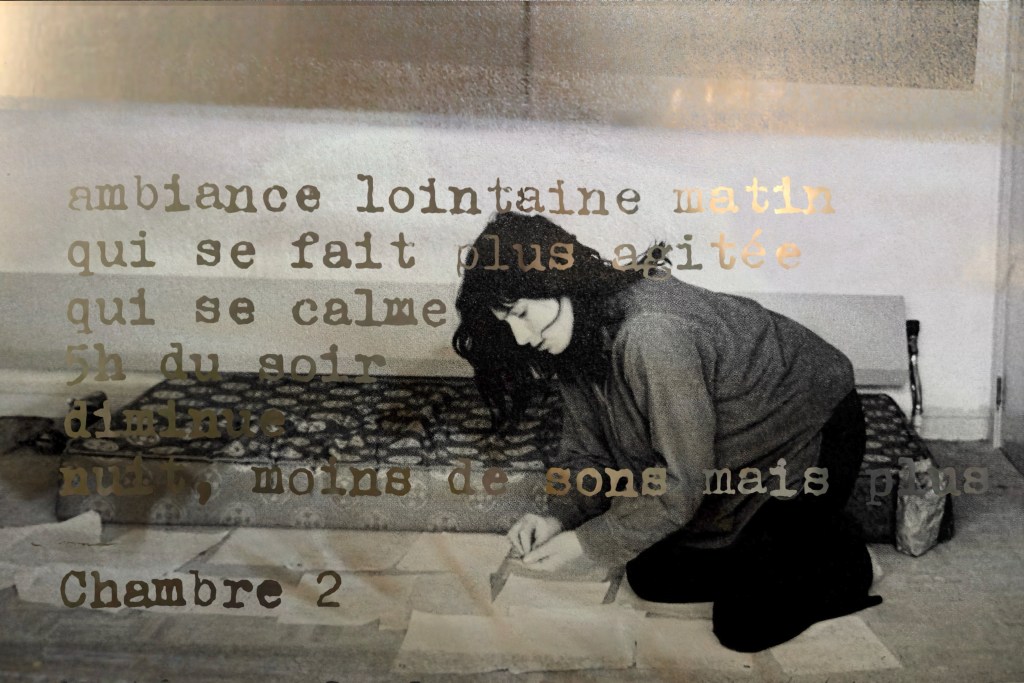
1959 June At the Terminus — one night “First night of total release blended with looks with surface gestures — Seamless connections of knowledge, of near absolute understanding, faultless, of a smile, of a word. The schedule kicks in mid-flight, returning the rhythm of day and night, of a familiar convention opposed only by the desire not to — instant guilt at the margins of the normal, the reassuring — So I set off on a tangent, from an unbroken sleep, into the rain and lively gusting wind; and the words, and the unformed phrases slide into tight…
Reading Danielle Collobert
John Taylor on Danielle Collobert Collobert (1940–78) is the author of five haunting books of prose and prose-like poetry which the Parisian publisher POL has just brought back from oblivion. It is both moving and fitting that Meurtre(Murder, 1964), Dire I (Say I, 1972), Dire II (Say II,1972), Il donc (It Then, 1976) and Survie (Survival, 1978) are now gathered under one cover, constituting the first volume of Collobert’s collected works, Oeuvres I. A second volume, Oeuvres II, comprising her journal, her several radio texts, and miscellaneous writings, will appear next year. This is no routine reissue. Pages by…
Peter Bouscheljong | GHOSTS ((A-234))
(i) … wir sind nichts als abgegriffene Bilder zeitgenössischer Vorstellungen. Das tragen wir dir nicht nach… aus dunklen Augenhöhlen brennt in eiskalter Berechnung der Tod Rimbauds das Hirn sich weggeblasen mit einem der 1440 Perkussionsschloss-Gewehren die absteigende Karawane ((Soldaten des guten Willens)) / Schauder der Büßermondlandschaft Abessiniens nasstriefende Trepanationen & Vokale ((Licht der additiven Farbmischung)) / die logischen Revolten für den Anfang :: Triebfeder zerschlagener Ideen, langue à langue kartographiert im Schwarz getünchter Schadensregister (ii) kein Sterblicher der nicht in einem beliebigen Augenblick seines Daseins mit Zittern und Abscheu die seltsame Geschichte betrachtet die Versuche Luxus zu geniessen…
The Secret Art of Antonin Artaud | Jacques Derrida & Paule Thévenin
Translation and preface by Mary Ann Caws Antonin Artaud – stage and film actor, director, writer, drug addict, and visual artist – was a man of rage and genius. The Secret Art of Antonin Artaud is the first English translation of two famous texts on his drawings and portraits. In one, Jacques Derrida examines the works that he first saw on the walls of Paule Thévenin’s apartment. His text, as frenzied as Artaud’s, struggles with Artaud’s peculiar language and is punctuated by footnotes and asides the reflect this strain (“How will they translate this?”). The more straightforward text of Paule…
Antonin Artaud | Interjections [Suppôts et Suppliciations]
Wednesday 27 November 1946 at twenty-three hours in the evening beings that have not swallowed the nail, but have swallowed the point, and have held themselves between the hard and the soft, those one cannot disintricate because if one looks for them in the breath they take refuge in the body, and if one looks for them at one point on the body they claim to be braided there in breath, lightning gashing the body like a negation of body, having more body than all breath. They collect in the body, outside of the one who controls this body…
‘[A] poet must know more than | a surface suggests’: Reading and Secrecy in the Poetry of Anna Mendelssohn; by Vicky Sparrow
There are moments when the reader of Anna Mendelssohn’s poetry feels themselves to be initiated into a secret poetic world within her work; and there are moments when such a reader is explicitly, sometimes uncomfortably, disabused of such a fantasy, debarred from such a space. The construction and reading of poetry always requires a negotiation of what is part-private and part-public, and in Mendelssohn’s work the crossing between these can feel peculiarly perilous. In Implacable Art (2000) Mendelssohn titles and addresses a poem ‘to any who want poems to give them answers’, cautioning her readers: ‘a poem is not…
Gilles Deleuze & Félix Guattari | May ’68 Did Not Take Place
In historical phenomena such as the revolution of 1789, the Commune, the revolution of 1917, there is always one part of the event that is irreducible to any social determinism, or to causal chains. Historians are not very fond of this point: they restore causality after the fact. Yet the event itself is a splitting off from, a breaking with causality; it is a bifurcation, a lawless deviation, an unstable condition that opens up a new field of the possible. In physics, Ilya Prigogine spoke of states in which the slightest differences persist rather than cancel themselves out, and…
Kristin Ross; May ’68 and its Afterlives
Kristin Ross; MAY ’68 AND ITS AFTERLIVES (Full book) During May 1968, students and workers in France united in the biggest strike and the largest mass movement in French history. Protesting capitalism, American imperialism, and Gaullism, 9 million people from all walks of life, from shipbuilders to department store clerks, stopped working. The nation was paralyzed—no sector of the workplace was untouched. Yet, just thirty years later, the mainstream image of May ’68 in France has become that of a mellow youth revolt, a cultural transformation stripped of its violence and profound sociopolitical implications. Kristin Ross shows how the current…
Jacques Rancière; Disagreement: Politics and Philosophy
Jacques Rancière; Disagreement: Politics and Philosophy (Full book) “Is there any such thing as political philosophy?” So begins this provocative book by one of the foremost figures in Continental thought. Here, Jacques Rancière brings a new an highly useful set of terms to the vexed debate about political effectiveness and “the en of politics.” What precisely is at stake in the relationship between “philosophy” and the adjective “political”? In Disagreement, Rancière explores the apparent contradiction between these terms and reveals the uneasy meaning of their union in the phrase “political philosophy”—a juncture related to age-old attempts in philosophy to answer…
Aimé Césaire; Discourse on Colonialism
Aimé Césaire; Discours on Colonialism (Full book) A Poetics of Anticolonialism; by Robin D.G. Kelly Aimé Césaire’s Discourse on Colonialism might be best described as a declaration of war. I would almost call it a “third world manifesto,” but hesitate because it is primarily a polemic against the old order bereft of the kind of propositions and proposals that generally accompany manifestos. Yet, Discourse speaks in revolutionary cadences, capturing the spirit of its age just as Marx and Engels did 102 years earlier in their little manifesto. First published in 1950 as Discours sur le colonialisme1, it appeared just…